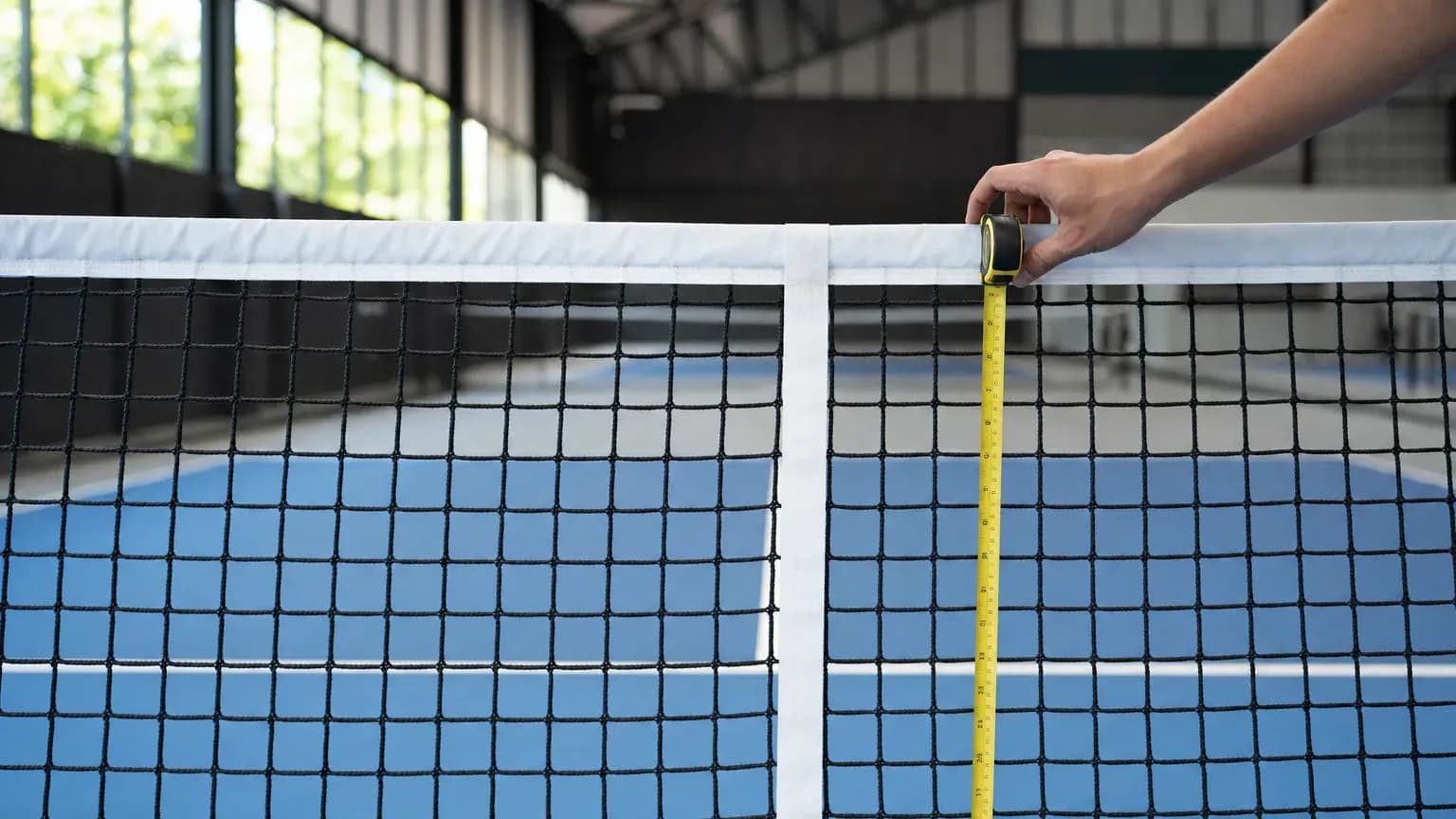
A pickleball net is 36 inches tall at the sidelines and 34 inches tall at the center of the court, per the 2026 USA Pickleball Official Rulebook. Each height has a tolerance of plus or minus a quarter inch. Measure from the playing surface to the top of the net: at the point where the net crosses the outer edge of each sideline, and at the center point of the court. If the net has a center strap, the center measurement includes it.
This guide covers the full net and post specs, how pickleball compares with tennis, badminton and padel nets, and how to keep every net at a facility in spec.
Official pickleball net specifications
Everything in the table below is from Rule 3.B of the 2026 USA Pickleball rulebook.
Spec | Requirement |
|---|---|
Height at the sidelines | 36 in (91.44 cm) ± 0.25 in |
Height at the center | 34 in (86.36 cm) ± 0.25 in, including any center strap |
Post spacing | 22 ft (6.71 m) ± 1 in, inside of post to inside of post |
Post diameter | 3 in (7.62 cm) maximum |
Net length | At least 21 ft 9 in (6.63 m), post to post |
Net depth (bottom edge to top) | At least 30 in (76.2 cm) |
Top binding | 2 in (5.08 cm) white tape over a cord or cable, resting on the cord or cable |
Center strap (optional) | Centered 10 ft from the outside edge of each sideline |
Material | Any mesh fabric that a ball can't pass through |
The quarter-inch tolerance is tighter than many people expect. A net that measures 35 or 37 inches at a sideline is out of spec.
How to measure a pickleball net
You need a tape measure or, better, a net measuring stick marked at 34 and 36 inches.
- Check the center first. Find the midpoint of the net, which is also where the centerlines would meet if they were extended. Measure from the court surface straight up to the top of the net, including the strap if there is one. Adjust the strap until it reads 34 inches.
- Check both sidelines. Measure where the net crosses the outer edge of each sideline, not at the posts. Both should read 36 inches.
- Adjust the tension, then recheck the center. Tightening the cable raises the sideline height and can pull the center up too. Work back and forth until all three points are in spec.
- Check the posts. Measure inside to inside. They should be 22 feet apart, give or take an inch.
If the sidelines are right but the center is too high even with the strap at its tightest, the cable is probably overtensioned. Loosen it a little and readjust.
Pickleball vs tennis, badminton and padel nets
Facilities that share space often ask whether one net can serve two sports. Here are the official heights from each sport's governing body.
Sport | Center height | Height at sidelines or posts | Source |
|---|---|---|---|
Pickleball | 34 in | 36 in at the sidelines | USA Pickleball rulebook |
Tennis | 36 in (0.914 m) | 42 in (1.07 m) at the posts | ITF Rules of Tennis |
Badminton | About 60 in (1.524 m) | About 61 in (1.55 m) at the doubles sidelines | BWF Laws of Badminton |
Padel | About 34.6 in (0.88 m) | Up to about 36.2 in (0.92 m) at the ends | FIP Rules of Padel |
A few practical points:
- Tennis to pickleball: you can drop a tennis net to 34 inches at center with the strap, but because the tennis posts stand far outside the pickleball sidelines, the net will sit a bit higher than 36 inches where it crosses them. That's fine for casual play but not for tournaments. Our guide to playing pickleball on a tennis court covers the layout.
- Badminton to pickleball: a badminton net is about two feet too high. The court footprint is similar, but you need a separate pickleball net.
- Padel and pickleball: the heights are close, but padel nets are 10 meters long and hang inside a walled court. They aren't interchangeable.
Permanent vs portable nets
| Permanent net system | Portable net |
|---|---|---|
Setup | Posts set in sleeves or footings; always ready | Assembled for each session |
Keeping height in spec | Easier; tension holds between checks | Varies; must be checked every setup |
Best for | Dedicated courts, clubs, tournaments | Shared courts, gyms, pop-up programs |
Risk | Posts are permanent objects players can run into | Bases and feet can be a trip hazard; bases dragged across courts can scuff the surface |
Storage | None | Needs a secure storage spot |
The rulebook treats net posts, including their wheels, arms and legs, as permanent objects. A served ball that hits any part of the net support system is a fault. In a rally, a ball that crosses the net and then hits a crossbar or other part of the net support system inside the court boundaries is replayed. That's a good reason to keep portable net bases tucked outside the court lines where you can.
What happens when the ball hits the net?
The 2026 rulebook keeps these rules simple:
- On the serve: a served ball that touches the net and still clears the kitchen and lands in the correct service court is in play. There's no "let" replay.
- During a rally: a ball that touches the net or the cable at the top between the posts stays in play.
- Between the net and the post: hitting the ball through the gap between the net and the post is a fault.
- Around the post: a ball can legally go around the outside of the net post.
- Players touching the net: a player, their paddle or anything they're wearing can't touch the net or net system while the ball is live.
Common net problems and fixes
Problem | Likely cause | Fix |
|---|---|---|
Center too high even with the strap tight | Cable overtensioned | Loosen the cable a little, then reset the strap to 34 inches |
Center too low | Strap stretched or set too tight | Replace or let out the strap, then recheck both sidelines |
One sideline higher than the other | Uneven tension or a leaning post | Check that posts are plumb and the cable is seated at the same height on both |
Net sags more each week | Stretched cable or worn binding | Retension the cable and replace worn binding before it tears |
Portable net leans or creeps | Base not square to the court, or set on an uneven surface | Square the frame to the sidelines and check the height after every move |
Players complain about the net on one court only | A net that drifts out of spec faster than the rest | Log daily readings by court number to spot it, then replace parts |
Facility net checklist
For a club or facility, nets that drift out of spec generate complaints, especially from league and ladder players. A simple routine helps:
- Daily opening check: center and both sidelines on every court, with a marked measuring stick kept at the front desk.
- Label each net. Number nets to match courts so you can track which ones keep sagging.
- Inspect the binding and mesh weekly for tears that let the ball through. The rulebook requires a mesh that won't let a ball pass.
- Check cables and straps monthly for fraying or stretched webbing.
- Keep spare straps and a cable tensioner on site.
- After a tournament or event, recheck every court before regular bookings resume.
- Outdoor courts: recheck after big temperature swings, which can change cable tension.
- Portable nets: train staff to measure every time they set up, and store nets assembled where possible to cut setup time.
If you're laying out new courts, the pickleball court dimensions guide covers post placement, runoff and how many courts fit in a space.
Keeping courts ready for bookings
Nets out of spec are one of those small things that make players think a facility isn't well run. Building a net check into opening procedures, and blocking a few minutes between big events and regular bookings, keeps courts ready for whoever booked them next.
Sports Booking Management gives each court its own operating hours and booking rules, so you can block time for setup, maintenance or net changes without anyone booking over it. Players book from a public booking page, pay through Stripe checkout and can add paddle or net rental as an add-on. Learn more on our pickleball facility page.