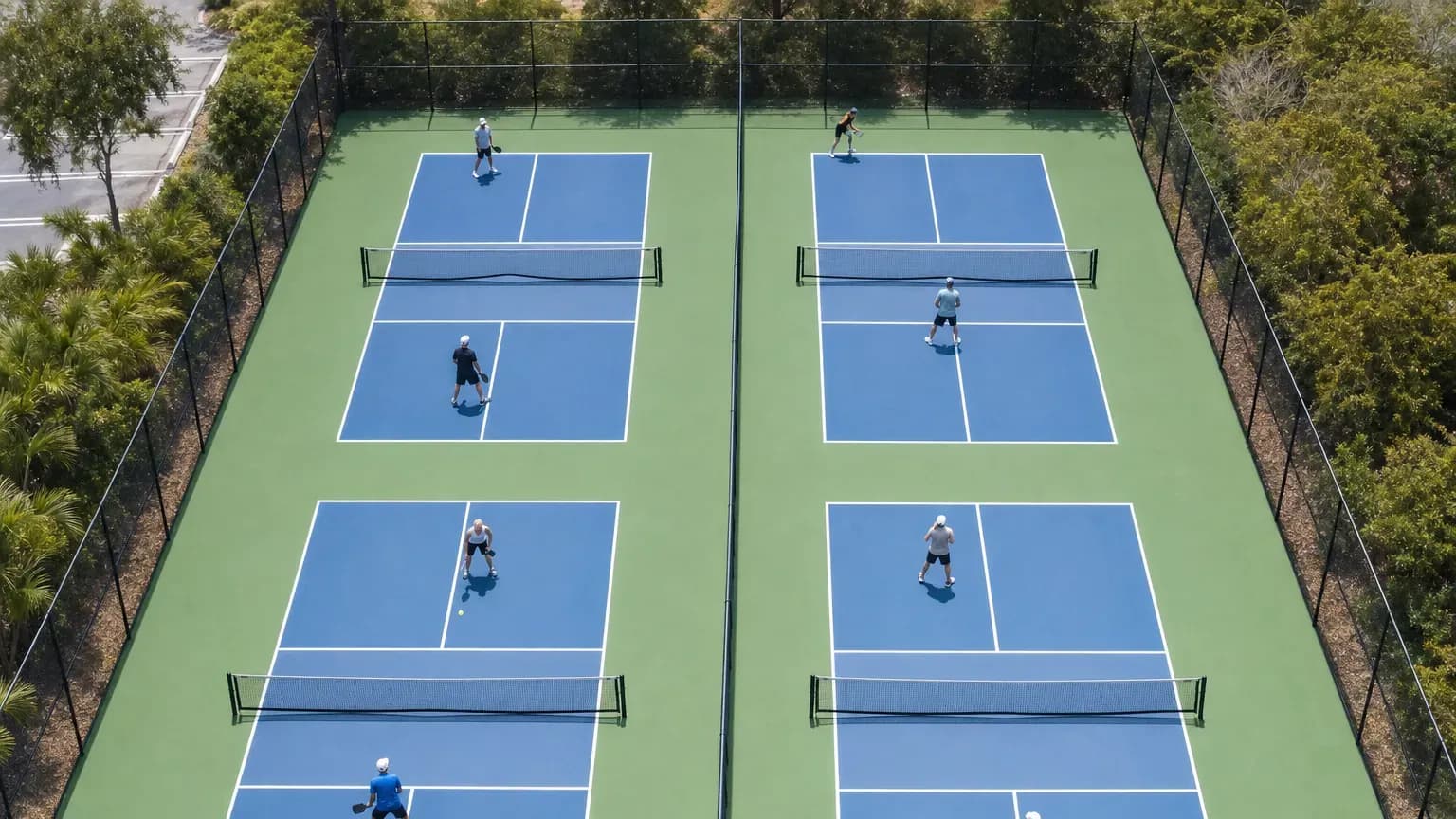
A regulation pickleball court is 20 feet wide and 44 feet long (6.10 × 13.41 meters), the same for singles and doubles, per the 2026 USA Pickleball Official Rulebook. A 7 foot non-volley zone, or "kitchen," sits on each side of the net, leaving a 15 foot deep service area behind it that's split into left and right service courts by a centerline. All lines are 2 inches wide and are measured to their outside edge. Around the court, USA Pickleball sets a minimum playing surface of 30 × 60 feet, and recommends 34 × 64 feet for new construction.
This guide covers every measurement, then the runoff, net and layout numbers you need if you're building or lining courts.
Official pickleball court dimensions
All figures below come from Section 3 of the 2026 USA Pickleball rulebook.
Element | Measurement |
|---|---|
Court length | 44 ft (13.41 m) |
Court width | 20 ft (6.10 m) |
Non-volley zone (each side) | 7 ft deep × 20 ft wide |
Service court (each of four) | 10 ft wide × 15 ft deep |
Line width | 2 in (5.08 cm) |
Where to measure | To the outside edge of the perimeter and non-volley zone lines |
Net height at sidelines | 36 in (± 0.25 in) |
Net height at center | 34 in (± 0.25 in) |
Net post spacing | 22 ft (± 1 in), inside of post to inside of post |
Net length | At least 21 ft 9 in |
The lines and what they mean
- Baselines run parallel to the net at each end, 22 feet from the net.
- Sidelines run the full 44 foot length on each side.
- Non-volley zone lines run parallel to the net, 7 feet from it. The rulebook counts these lines as part of the non-volley zone, so standing on the line while volleying is a fault. A serve that lands on the kitchen line is out.
- Centerlines run from the non-volley zone line back to the baseline on each side. They split the right and left service courts.
All lines should be the same color and clearly contrast with the court surface, per the rulebook.
Playing surface and runoff
The court is only part of the space you need. Players chase lobs and wide balls beyond the lines, and the rulebook treats the area around the court as part of the playing surface.
Purpose | Total playing surface (USA Pickleball) | Runoff beside each sideline | Runoff behind each baseline |
|---|---|---|---|
Minimum | 30 × 60 ft (1,800 sq ft) | 5 ft | 8 ft |
New construction | 34 × 64 ft (2,176 sq ft) | 7 ft | 10 ft |
Tournament play | 34 × 64 ft (2,176 sq ft) | 7 ft | 10 ft |
Stadium court | 50 × 80 ft (4,000 sq ft) | 15 ft | 18 ft |
The runoff figures are the total playing surface minus the court, split evenly on each side. When courts sit side by side, they share the runoff between them. Two courts at the minimum size need 10 feet between their sidelines (5 feet for each), not 20.
If you have the room, build to 34 × 64. Players in competitive play and drills cover a lot of ground behind the baseline, and more space between courts also means fewer stray balls and hinders.
How many pickleball courts fit in your space?
Here's a planning table for clear floor area, using the rulebook's minimum (30 × 60 ft) and recommended (34 × 64 ft) playing surfaces. It assumes courts run in the same direction and that there are no columns in the playing area. It counts court space only. Lobby, restrooms, seating, storage and walkways come on top.
Clear area (width × length) | Square feet | Courts at 30 × 60 | Courts at 34 × 64 |
|---|---|---|---|
60 × 120 ft (a typical tennis court enclosure) | 7,200 | 4 | 1 |
90 × 120 ft | 10,800 | 6 | 2 |
120 × 128 ft | 15,360 | 8 | 6 |
136 × 128 ft | 17,408 | 8 | 8 |
170 × 128 ft | 21,760 | 10 | 10 |
204 × 192 ft | 39,168 | 18 | 18 |
Two things stand out. First, the "four courts on a tennis court" layout only works at the 30 × 60 minimum. Second, a few extra feet of width can unlock a whole court, so measure the clear space between walls or columns carefully before you settle on a court count. A building's overall size can be misleading if columns sit inside the court zone.
Converting a tennis court to pickleball
A US tennis court enclosure is usually about 60 × 120 feet. Per the ITF Rules of Tennis, a doubles tennis court is 78 × 36 feet, and the ITF recommends 21 feet of space behind each baseline and 12 feet beside each sideline, which adds up to that 60 × 120 footprint.
You have three main options:
- Overlay one or two pickleball courts in a contrasting line color and keep the tennis lines. Players bring portable nets. This keeps the court usable for both sports.
- Play across the tennis net. A 44 foot pickleball court centered on the tennis net puts each pickleball baseline just 1 foot behind the tennis service line, which is 21 feet from the net. The tennis net is 36 inches at center and 42 inches at the posts, so it needs to come down to 34 inches at center using the center strap.
- Convert to four dedicated pickleball courts. Remove the tennis net and posts, resurface, paint four courts and install four permanent net systems. Each court gets the 30 × 60 minimum playing surface.
Our guide to playing pickleball on a tennis court covers the trade-offs, including how to schedule a shared court.
Net and post placement
The rulebook places net posts 22 feet apart, measured inside to inside, which puts each post about 1 foot outside the sideline. Posts should be no more than 3 inches in diameter. The net should be at least 21 feet 9 inches long and at least 30 inches from top to bottom, with a 2 inch white binding over a cord or cable. A center strap 10 feet from the outside edge of each sideline holds the center at 34 inches.
For the details of measuring and adjusting nets, see our pickleball net height guide.
Planning checklist for new courts
Use this checklist before you sign off on a layout:
- Playing surface: at least 30 × 60 feet per court, 34 × 64 if you can.
- Orientation: outdoor courts are usually laid out roughly north–south to keep the low sun out of players' eyes.
- Columns and obstructions: nothing inside the playing surface. The rulebook treats ceilings, walls, fences, light fixtures and net posts as permanent objects, and a ball that hits one before it bounces is a fault against the player who hit it.
- Ceiling height (indoor): the rulebook doesn't set a minimum. Low ceilings and hanging lights still cut off lobs, so ask your court builder what your planned level of play needs.
- Divider netting: curtains or nets between courts cut down on balls rolling into the next game.
- Line color: one contrasting color for all pickleball lines. On shared courts, pick a different color from the tennis or basketball lines.
- Gates and walkways: access to each court without crossing another court's playing area.
- Lighting: even light across the whole playing surface, not just the court. Have a lighting designer specify levels for your intended use.
- Drainage and slope (outdoor): follow your court builder's spec so water doesn't pool on the court.
Turning court space into bookable hours
Once your courts are built, your revenue comes down to how many hours each one is booked. Give each court its own operating hours, set peak and off-peak rates, and keep prime time for leagues and rentals that pay the most. Our guide to how much a pickleball court costs helps with the build budget.
Sports Booking Management lets you list each court as its own bookable space with its own hours and booking rules. Players see availability and book on a public page, and you can embed a booking button on your website. Recurring bookings cover weekly leagues, and paddle rental can be added to any booking. Learn more on our pickleball facility page.