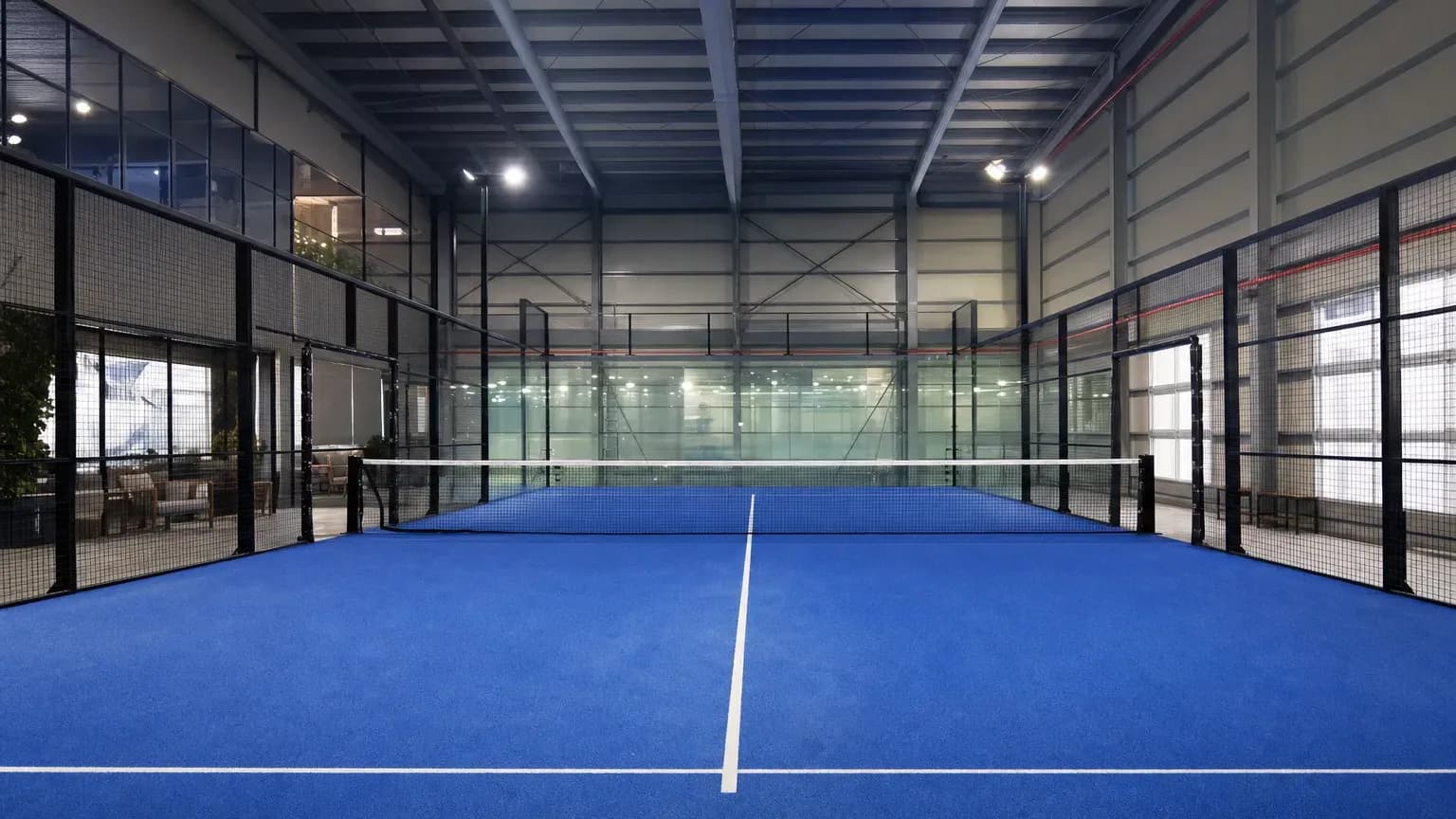
A padel court is 20 meters long and 10 meters wide (65 ft 7 in x 32 ft 10 in), measured inside the walls, per the International Padel Federation (FIP) Rules of Padel. The service lines sit 6.95 m (22 ft 10 in) from the net, which is 0.88 m (34.6 in) high at the center and 0.92 m (36.2 in) at the ends. The court is fully enclosed, with 4 m (13 ft 1 in) end walls and stepped side walls. Indoors, the FIP requires at least 6 m (19 ft 8 in) of clear height and suggests 8 m (26 ft 3 in) for new facilities. You'll also need room around the cage for the frame, walkways and, if you allow it, out-of-court play.
This guide gives each FIP measurement in meters and feet, then the space and building checks an owner needs before ordering courts.
Official padel court dimensions (FIP)
Every number below is from the FIP Rules of Padel. The rules give dimensions in meters; the feet figures are conversions.
Element | Meters | Feet and inches |
|---|---|---|
Court length (inside walls) | 20 m | 65 ft 7 in |
Court width (inside walls) | 10 m | 32 ft 10 in |
Playing area | 200 m² | 2,153 sq ft |
Tolerance on length and width | ±0.5% | ±0.5% |
Net to service line | 6.95 m | 22 ft 10 in |
Service line to back wall | 3.05 m | 10 ft 0 in |
Central service line extension past the service line | at least 0.20 m | at least 7.9 in |
Line width | 5 cm | 2 in |
Net length | 10 m | 32 ft 10 in |
Net height at center | 0.88 m | 34.6 in |
Net height at ends | 0.92 m | 36.2 in |
Maximum net post height | 1.05 m | 41.3 in |
Minimum clear height over the court | 6 m | 19 ft 8 in |
Suggested clear height for new facilities | 8 m | 26 ft 3 in |
A few points worth knowing:
- The court has no baseline. The back wall is the end of the court. Lines only mark the service boxes.
- The 0.5 percent tolerance is small. On a 20 m court that's 10 cm either way. Court manufacturers build to the internal size, so the steel frame and glass sit outside these numbers.
- Line color. The FIP prefers white or black lines, chosen for contrast with the floor.
- Floor color. The FIP allows green, blue or terracotta (or similar tones), as one color across the floor and clearly different from the walls.
Wall heights and layout
The enclosure is what makes padel different from other racket sports, and the walls are part of the playing area. Per the FIP rules:
Wall section | Height | Length | Material |
|---|---|---|---|
End wall, lower section | 3 m (9 ft 10 in) | full 10 m width | Glass or other solid material with a uniform bounce |
End wall, top section | 1 m (3 ft 3 in), for 4 m (13 ft 1 in) total | full 10 m width | Metal mesh |
Side wall, Variant 1, first step | 3 m (9 ft 10 in) | 2 m (6 ft 7 in) from each end | Glass or solid wall |
Side wall, Variant 1, second step | 2 m (6 ft 7 in) | next 2 m (6 ft 7 in) | Glass or solid wall |
Side wall, Variant 2 ("crystal") | 3 m (9 ft 10 in) | 4 m (13 ft 1 in) from each end, no step | Glass |
Side mesh, outer 2 m at each end | up to 4 m (13 ft 1 in) | 2 m | Metal mesh |
Side mesh, center 6 m | up to 3 m (9 ft 10 in) | 6 m (19 ft 8 in) | Metal mesh |
The FIP also sets rules for the mesh itself: welded or twisted wire with diamond openings between 5 and 7.08 cm on the diagonal, and wire recommended at 2 to 3 mm thick. In practice, you buy a court from a manufacturer who builds to these specs. Ask for confirmation in writing that the court meets the FIP rules, especially if you plan to host sanctioned events.
Access openings
Players enter through openings in the side walls, placed symmetrically around the net. You can have one or two openings per side, with or without doors.
Openings per side | Minimum size | Maximum size |
|---|---|---|
One | 1.05 x 2.00 m (3 ft 5 in x 6 ft 7 in) | 2.20 x 2.20 m (7 ft 3 in x 7 ft 3 in) |
Two | 0.72 x 2.00 m (2 ft 4 in x 6 ft 7 in) | 1.10 x 2.20 m (3 ft 7 in x 7 ft 3 in) |
The FIP requires padding at least 2 cm thick on the sides and top of each opening and on the net posts. If doors are fitted, handles go on the outside so nothing sticks into the court. Public facilities also need to meet local accessibility codes.
Total space for a padel court
The 20 x 10 m internal size isn't your footprint. Plan for three layers around it.
1. The court structure. Posts, glass clamps and frame sit outside the internal dimensions. Get the exact external footprint from your manufacturer, since it varies by model.
2. Out-of-court play (optional). Padel lets players run outside the cage through the side openings to play a ball back. To allow this, the FIP requires a clear area outside each side of the court that's at least 3 m wide (4 m recommended), 4 m long and 3 m high, with no obstacles. Light poles inside that area mean out-of-court play isn't allowed.
3. Circulation. Players need walkways to reach each court, plus space for benches, a ball machine and spectators.
Worked layout example
Here's how the numbers add up for a row of courts set side by side. This is an illustration with stated assumptions, not a design. We assume 0.5 m of structure on each side of the cage (check your manufacturer's figure) and a 2 m walkway along one end of the row.
Layout | Width per court (across the row) | Length of row | Notes |
|---|---|---|---|
1 court, no out-of-court play | about 11 m (36 ft) | about 23 m (75 ft) | Structure plus walkway |
1 court, out-of-court play, 3 m each side | about 17 m (56 ft) | about 23 m (75 ft) | 3 m clear zone on both sides |
1 court, out-of-court play, 4 m each side | about 19 m (62 ft) | about 23 m (75 ft) | FIP-recommended clear zone |
3 courts in a row, no out-of-court play, 1.5 m between cages | about 36 m (118 ft) | about 23 m (75 ft) | Typical club layout |
3 courts in a row, out-of-court play on every side, 3 m zones not shared | about 51 m (167 ft) | about 23 m (75 ft) | Rarely practical indoors |
The takeaway: out-of-court play costs roughly 6 to 8 meters of width per court. Many indoor clubs skip it on most courts and keep one show court with full clear zones for events and advanced players.
Ceiling height and lighting for indoor padel
Height is the first thing to check in any building you're considering. Per the FIP rules:
- Minimum clear height: 6 m (19 ft 8 in) over the entire court, with nothing hanging into that space.
- Suggested for new builds: 8 m (26 ft 3 in) over the entire court.
- Light fixtures: the bottom of the fixtures must be at least 6 m above the floor. For new facilities with lights mounted over the court (within the line of the side walls), the FIP suggests 8 m.
- Lighting quality: light has to be uniform and placed so it doesn't impair players, officials or spectators. Lux targets are set in the FIP court homologation annex. Broadcast and filming need at least 1,000 lux of vertical light, per the rules.
Measure clear height to the lowest truss, duct, sprinkler line or light, not to the roof deck. Lobs are central to padel, so a building with 6 m clearance will feel tight to experienced players.
Surface, slope and orientation
- Surface: the FIP allows concrete, synthetic material or artificial turf, as long as the bounce is regular. Most new clubs use sand-filled artificial turf.
- Flatness: level differences must be under 3 mm measured with a 3 m straightedge.
- Slope: on outdoor surfaces without drainage, the FIP allows a maximum transverse slope of 1 percent from the center toward the sides.
- Orientation (outdoor): the FIP recommends the long axis run north–south, with some variation toward north-northeast or north-northwest.
How many padel courts fit on tennis courts?
A full tennis enclosure is typically 60 by 120 feet (18.29 x 36.58 m), as covered in our tennis court dimensions guide. That's narrower than the 20 m length of a padel court, so a padel court won't sit across a single tennis enclosure, and only one fits lengthwise.
Conversions work better across a battery. Two tennis courts side by side with 12 feet between them take about 108 x 120 feet (32.92 x 36.58 m). Using the assumptions in the worked example above (11 m per cage, 1.5 m between cages, 2 m walkway), three padel courts without out-of-court play fit in that space with a little to spare. Have your manufacturer confirm with the real external footprint before you commit. Whether the swap is worth it depends on local demand, which our padel vs pickleball comparison covers.
Pre-order checklist
Before you sign a court order or a lease, confirm:
- Internal court size is 20 x 10 m, within 0.5 percent
- Wall variant (stepped or crystal) and glass spec meet the FIP rules and homologation annex
- At least 6 m clear height over the whole court, and 8 m if you can
- Light fixtures sit at least 6 m above the floor and outside any out-of-court play area
- Access openings are sized for one or two per side and padded
- Decision made on out-of-court play, with 3–4 m clear zones where it's allowed
- Walkways to each court that don't cross another court's clear zone
- Manufacturer's external footprint and slab requirements in hand
For the build budget, see cost to build a padel court.
Booking padel courts once they're open
Padel is played as doubles, so each booking brings four players, and courts at most clubs are sold in 60- or 90-minute slots. A booking system for padel clubs keeps those slots organized and paid for.
With Sports Booking Management, each court has its own hours, rates and booking rules, so a show court can be priced above the rest. Players see open times on a public booking page and book without creating an account, and they pay through Stripe checkout. Racket and ball rental can be added to a booking, and recurring bookings hold weekly groups and league nights. It's one plan at $79 a month with unlimited courts and bookings.