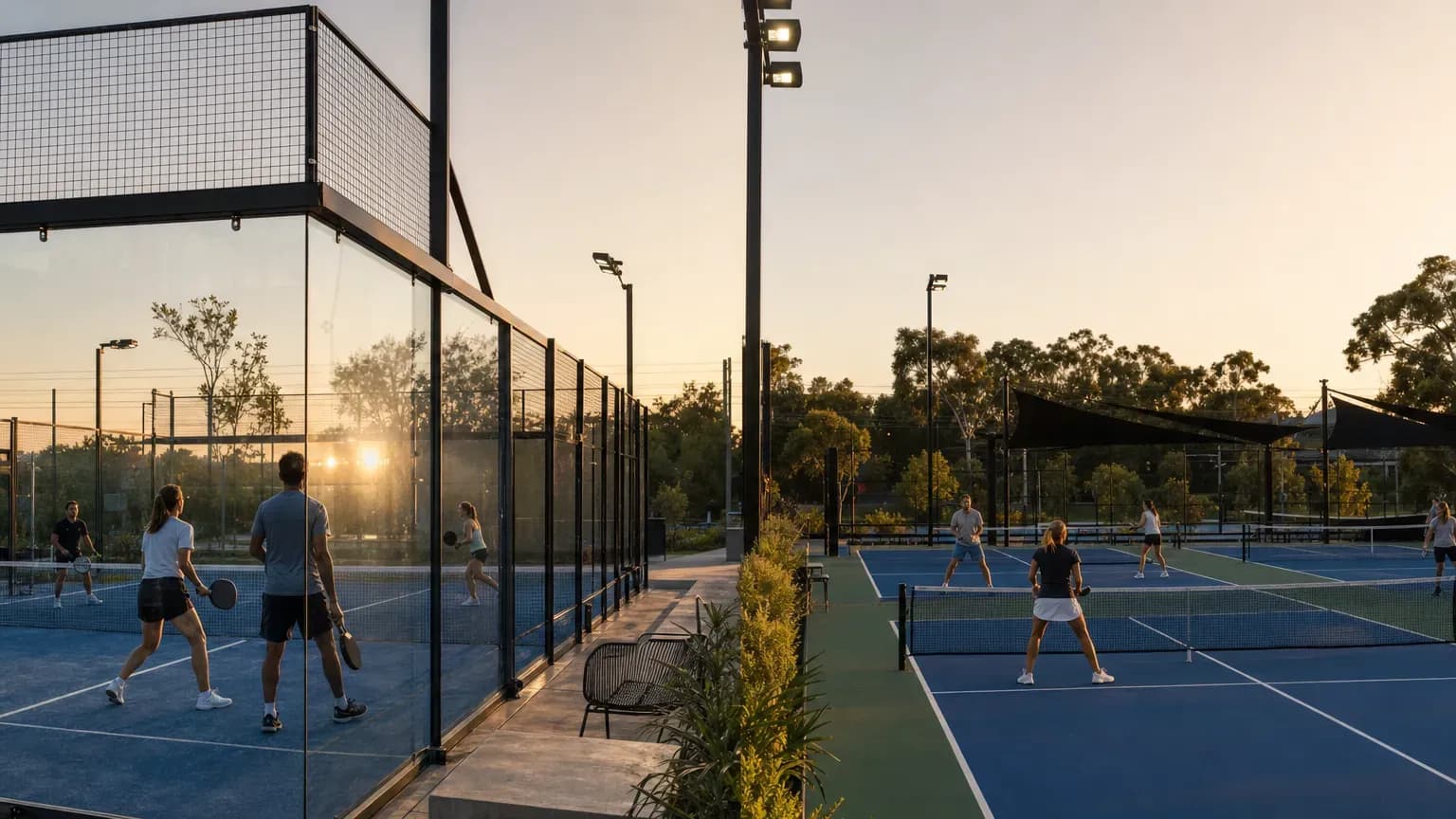
Padel and pickleball are both fast-growing paddle sports, usually played as doubles, but they're built very differently. Pickleball is played on an open 20 by 44 foot court with a 7 foot no-volley zone, a perforated plastic ball and an underhand serve. Padel is played on a 10 by 20 meter court (about 33 by 66 feet) that is fully enclosed by glass walls and mesh, with a pressurized ball that players can play off the walls. For a facility, the biggest differences are space, ceiling height and build cost: one tennis court footprint holds four pickleball courts but only one padel court.
This guide compares the two sports for players first, then for anyone deciding which one to add to a club or facility.
Padel vs pickleball at a glance
The table below uses the 2026 USA Pickleball Official Rulebook and the International Padel Federation (FIP) Rules of Padel in effect from January 1, 2026.
| Pickleball | Padel |
|---|---|---|
Court size | 20 × 44 ft (6.10 × 13.41 m) | 10 × 20 m inside (about 32.8 × 65.6 ft) |
Enclosure | None; open sides | Fully enclosed: glass back walls, glass and mesh side walls |
Walls in play | No | Yes, after the ball bounces |
Net height | 34 in at center, 36 in at sidelines | 0.88 m (about 34.6 in) at center, up to 0.92 m at the ends |
No-volley area | 7 ft "kitchen" on each side of the net | None; volleys allowed anywhere |
Ball | Perforated plastic ball | Pressurized felt ball, 6.35–6.77 cm diameter |
Bat | Solid paddle; length plus width up to 24 in, length up to 17 in | Solid perforated racket, up to 45.5 cm long, 26 cm wide, 38 mm thick |
Serve | Underhand volley serve or drop serve; one attempt | Bounce the ball, then hit at or below waist height; two attempts |
Scoring | Games usually to 11, win by 2 | Tennis-style: 15, 30, 40, game; sets of six games |
Format | Singles and doubles | Almost always doubles |
How the court and walls change the game
Pickleball is an open-court game. The ball must land inside the lines, and once it's past you, the point is usually over. The 7 foot non-volley zone on each side of the net stops players from volleying close to the net, which is why so much of the game is soft "dinking" at the kitchen line.
Padel is a wall game. The ball must bounce on the floor of the opponent's side first, but after that it can rebound off the glass and players can still return it. That turns a ball that would be a winner in tennis or pickleball into a second chance. Rallies tend to be long, and positioning matters more than raw power.
The padel court is also much bigger in area. At about 2,150 square feet inside the walls, it's more than double the 880 square feet of lined area on a pickleball court.
Serving and scoring
Pickleball
Per the USA Pickleball rulebook, the serve goes diagonally and must clear the non-volley zone. A volley serve must be hit with an upward arc, below the waist, with the paddle head below the wrist. A drop serve lets the server drop the ball and hit it after it bounces. The server gets one attempt.
Then comes the two-bounce rule: the return of serve must bounce, and the serving team's next shot must also bounce, before anyone can volley.
In standard scoring, only the serving side scores, and games usually go to 11, win by 2. Doubles scores are called as three numbers (serving team's score, receiving team's score, server number). Rally scoring, where every rally earns a point, is a provisionally approved option in the 2026 rulebook.
Padel
Per the FIP rules, the server stands behind the service line, bounces the ball in their own service box and hits it at or below waist height. The serve goes diagonally into the receiver's box and gets two attempts, as in tennis.
Scoring follows tennis: 15, 30, 40, game, with sets to six games and a tie-break at 6–6. The 2026 FIP rules list three ways to settle deuce: traditional advantage, "golden point" (one deciding point at the first deuce) and "Star Point" (advantage is played twice, and a deciding point is played at the third deuce).
Which is easier to learn?
Both are easy to start, which is a big part of why they're growing.
- Pickleball has a short court and a slow ball, so a new player can rally in the first session. The rules (two-bounce, kitchen, server number) take a few games to absorb.
- Padel feels natural to tennis and squash players. New players often struggle with the walls at first: the instinct is to hit the ball before it reaches the glass instead of letting it come off.
Padel vs pickleball for facilities
If you're choosing which sport to add, the court comparison matters less than the space, build and revenue comparison.
Space and ceiling height
The USA Pickleball rulebook sets a minimum playing surface of 30 × 60 feet per court (1,800 square feet), with 34 × 64 feet recommended for new construction. That means the common 60 × 120 foot tennis court enclosure fits four pickleball courts at the minimum size.
A padel court is 10 × 20 meters inside its walls, plus the thickness of the structure. Panoramic courts that allow play outside the court through the side openings also need clear space beside the doors. The FIP rules call for at least 3 meters wide (4 meters recommended) and 4 meters long on each side for that. A 60 × 120 foot tennis enclosure fits one padel court.
Ceiling height is where indoor padel gets expensive. The FIP rules require at least 6 meters (about 19.7 feet) of clear height over the whole court and suggest 8 meters (about 26 feet) for new facilities. The USA Pickleball rulebook doesn't set a ceiling height. Low ceilings still catch lobs, so ask your court builder what your planned level of play needs.
Build cost
These are typical US quotes, not bids. Prices vary by region, site and finish.
Item | Pickleball | Padel |
|---|---|---|
Court on an existing sound slab or surface | About $8,000–$25,000 per court for surfacing, lines and nets (indoor acrylic or cushioned) | Not applicable; the enclosure is the court |
Court structure and glass | None needed | Commonly $15,000–$40,000 for the frame, glass and mesh; panoramic designs cost more |
Finished outdoor court with site work and lights | Varies widely; see our pickleball court cost guide | Commonly about $40,000–$120,000+, depending on foundations, glass, lighting and shipping |
Shipping, installation crews, foundations and local engineering add a lot to padel projects, so get a full turnkey quote rather than a structure-only price.
Revenue math per square foot
Both sports put four players on a court for a typical doubles booking. The difference is how many courts you can fit.
Space | Pickleball courts (USA Pickleball minimum 30 × 60 ft) | Padel courts |
|---|---|---|
One 60 × 120 ft tennis enclosure | 4 | 1 |
Two adjacent tennis enclosures (120 × 120 ft) | 8 | 2 to 3, depending on layout and side clearance |
So for padel to earn as much as pickleball from the same footprint, each padel hour has to earn several times more than a pickleball court hour, or stay booked when pickleball courts sit empty. In some markets it can: padel is often sold as a premium, booked-in-advance game, while pickleball leans on open play and drop-ins. Check local pricing before you assume either.
Decision matrix
Your situation | Leans pickleball | Leans padel |
|---|---|---|
Existing tennis courts you can convert | ✓ |
|
Large local pickleball community, crowded public courts | ✓ |
|
Indoor building under about 20 ft clear height | ✓ |
|
Target market of former tennis and squash players |
| ✓ |
Strong expat, European or Latin American population that already plays padel |
| ✓ |
Want to stand out where several pickleball clubs already exist |
| ✓ |
Tight capital budget | ✓ |
|
Want the most courts in the smallest space | ✓ |
|
Many multi-sport facilities don't pick one. A common approach is to open with pickleball on existing space, then add one or two padel courts once you know your members will pay for it.
Running padel and pickleball under one roof
If you offer both, keep them as separate spaces with their own rules. Padel courts usually book in 90 minute slots for a foursome, while pickleball works well in 60 or 90 minute rentals plus skill-level open play sessions. Pricing differs too, since each padel court carries more capital cost. Our pickleball court rental pricing guide covers how operators set those rates.
Sports Booking Management lets you set up padel and pickleball courts as separate spaces, each with its own hours, booking rules and rates, including flat or hourly pricing. Players book and pay through a public booking page with Stripe checkout, and racket or paddle rental can be added to a booking. It's one plan at $79/month with unlimited courts and bookings. See how it works for padel facilities and pickleball facilities.