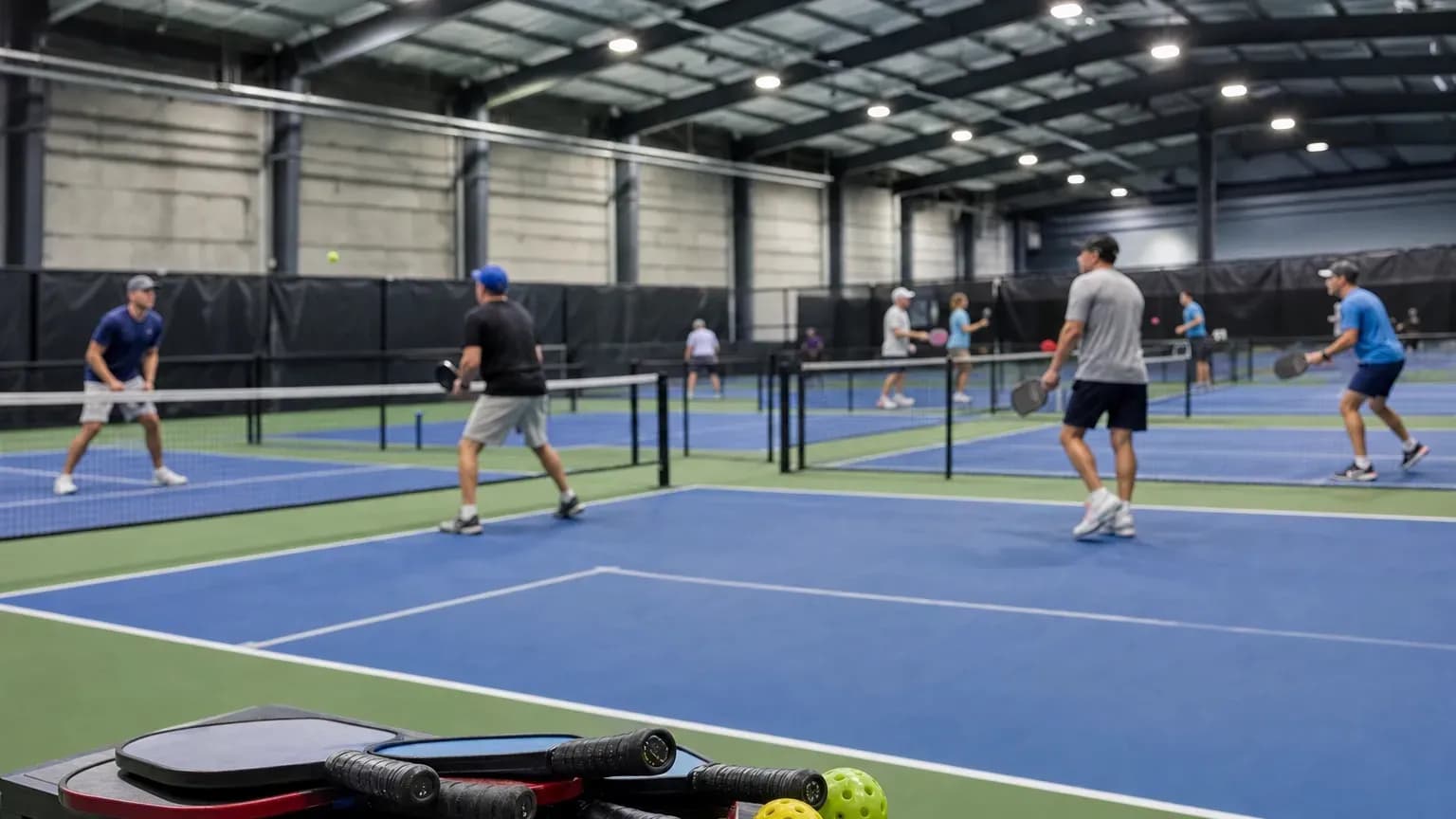
A pickleball court rental typically costs $5 to $16 an hour at a city park and $20 to $60 an hour at a private indoor club. Some clubs instead charge each player about $8 to $15 an hour. These ranges come from the published rate pages of US city parks departments, a few Canadian cities, and indoor clubs in suburban and big-city markets. Four things drive the price: whether the court is indoors, the time of day, whether you're a member (or a resident, at a city court), and the local market. Downtown indoor courts in big cities at weekday evening peak cost the most. Outdoor municipal courts on a weekday morning cost the least, and some cities don't charge at all for drop-in play.
The rest of this guide is for operators: how to build a rate card, where to set peak and off-peak lines, and how to handle deposits and no-shows.
What renters typically pay
Here's what the public rate pages we sampled show. Treat these as typical quotes, not averages, and check them against your own market.
Facility type | Typical price | What's usually included |
|---|---|---|
City park, outdoor, reservable | $5–$16 per court per hour | Court and net; sometimes a lower rate for courts without permanent nets |
City park, outdoor, drop-in | Free | First come, first served; often a rotation rule when people are waiting |
Canadian municipal courts | About CA$8–$20 per court per hour where booking is offered | Many cities keep outdoor courts free for drop-in and charge only for bookings |
Private indoor club, off-peak | $20–$45 per court per hour | Climate control, lighting, often ball and paddle rental for an extra fee |
Private indoor club, peak | $30–$60 per court per hour | Same, at weekday evenings and weekends |
Per-person pricing | About $8–$15 per player per hour | Usually a court minimum, so two players may pay the four-player price |
A few patterns showed up again and again:
- Members pay much less. At clubs that publish both rates, the member court rate is well below the non-member rate, and at some clubs it's half.
- Weekday daytime is the cheapest slot. Rates before 4 or 5 p.m. on weekdays run well below evening and weekend rates.
- Cities charge residents less. Where a parks department publishes a non-resident rate, it's higher, sometimes by a few dollars and sometimes by half again.
- Nets matter at city courts. Some cities charge less for a court where you bring your own portable net.
How operators set pickleball court rental rates
Most rate cards are built from four dials. You don't need all four on day one, but you should decide on purpose which ones you use.
1. Peak and off-peak
Demand for pickleball is uneven. Weekday evenings and weekend mornings fill first, and mid-afternoon on a weekday is hard to sell. Set your peak rate at what the local market pays for your best hours, then price off-peak low enough that someone changes their plans to use it.
A simple starting split:
- Peak: weekdays from 4 p.m. to close, plus weekends until mid-afternoon.
- Off-peak: weekdays from opening to 4 p.m., plus late weekend afternoons if they don't fill.
- Gap: keep off-peak at 60 to 75 percent of peak. If the gap is smaller, people don't bother to move. If it's bigger, you train regulars to wait for discounts.
Review the split after 8 to 12 weeks of bookings. If off-peak still doesn't fill, the price usually isn't what's wrong. Programming is the answer there: clinics, open play and daytime leagues. See how to start a pickleball business for how programming fits the wider plan.
2. Member and non-member
Memberships give you predictable revenue, and they give regulars a reason to book with you rather than at the club across town. The usual structure is:
- a monthly or annual fee
- a lower court rate (not free court time)
- an earlier booking window, such as 7 days ahead for members and 3 days for the public
Free court time for members sounds generous, but it fills your peak hours with players paying nothing on the margin. A discounted rate keeps every booking paying something.
3. Resident and non-resident (public operators)
City and county parks departments usually set a resident rate and a higher non-resident rate, because residents already fund the courts through taxes. If you run courts for a municipality, publish both rates and the proof of residency you accept (such as an ID or a utility bill). That saves arguments at the front desk.
4. Duration
Most clubs sell in 60- or 90-minute blocks, sometimes with 30-minute increments at peak. A 90-minute doubles booking suits recreational players. Pricing it at 1.5 times the hourly rate keeps things simple. Some clubs add a small premium for 30-minute bookings, because short slots leave awkward gaps that are hard to resell.
Deposits and no-shows
Pickleball bookings are cheap, so many people book casually and forget. If you're full at peak and someone doesn't show up, you've lost revenue you can't get back. The common approaches are:
- Pay in full at booking. This is the simplest. The customer pays online when they reserve, and your cancellation policy decides whether you refund them.
- Card on file with a late-cancellation charge. Common at clubs. The customer can cancel free up to a cutoff, often 24 hours, and late cancellations or no-shows pay the full court fee.
- Partial deposit. This is rare for single court hours. It's more common for group events, private parties and court buyouts, where a 25 to 50 percent deposit holds the date.
Whichever you choose, state it on the booking page and in the confirmation. A policy that isn't written down is hard to enforce.
A worked rate card example
Here's an example rate card for a hypothetical six-court indoor club in a mid-size suburban market. The numbers sit inside the ranges above, but they're an illustration, not a recommendation for your market.
Booking type | Off-peak (Mon–Fri, open–4 p.m.) | Peak (Mon–Fri 4 p.m.–close, Sat–Sun) |
|---|---|---|
Non-member, 60 minutes | $28 | $42 |
Non-member, 90 minutes | $42 | $63 |
Member, 60 minutes | $16 | $26 |
Member, 90 minutes | $24 | $39 |
Open play drop-in, per person, 2 hours | $10 | $14 |
Private event, 3 courts, 2 hours | $210 flat, 50% deposit | $300 flat, 50% deposit |
Paddle rental, add-on | $5 | $5 |
Before you publish, check the card against revenue. Suppose your six courts are open 14 hours a day, 7 days a week. That's 588 court-hours a week. If 35 percent of off-peak hours and 80 percent of peak hours sell at a blended non-member and member rate, how much do you bring in? Is it enough to cover rent, staff and utilities? If not, more members won't save you. Your rates, your hours or your court count are the problem.
Running costs to cover in your rate
Your hourly rate has to cover more than rent. When you set your price floor, add up these costs and divide by the court-hours you expect to sell:
- rent or mortgage and property tax
- utilities, especially lighting and HVAC for indoor courts
- staff at the front desk and for opening and closing
- insurance (general liability at a minimum)
- court resurfacing and net replacement, set aside monthly
- payment processing fees
- booking software and other subscriptions
If you're still building, add debt service on construction costs too, since these rates have to pay it back.
Converting a tennis court or shared space
Many facilities add pickleball by lining existing tennis courts. Per the USA Pickleball rulebook, a pickleball court measures 20 by 44 feet, so you can fit up to four on one tennis court with portable nets. Price a converted court with that in mind: four pickleball courts can earn more per hour than one tennis court rental, but only if you can fill them. Can you play pickleball on a tennis court covers the layout and line-color questions.
How to run your court rentals with booking software
Once your rate card is set, the operational job is making sure every booking is charged the right rate and paid before the customer arrives. A booking system for pickleball facilities handles that.
In Sports Booking Management, each court can have its own rate. You can also set pricing tiers by booking length, such as hourly, half day or a flat fee for an event. Customers see availability on a public booking page and book without creating an account. They can pay online through Stripe checkout, or you can send an invoice for group bookings. Recurring bookings cover weekly league nights and regular groups. You can also add paddle or ball rental as an add-on to a booking. The plan is $79 a month with unlimited courts and bookings. See pricing for the details.