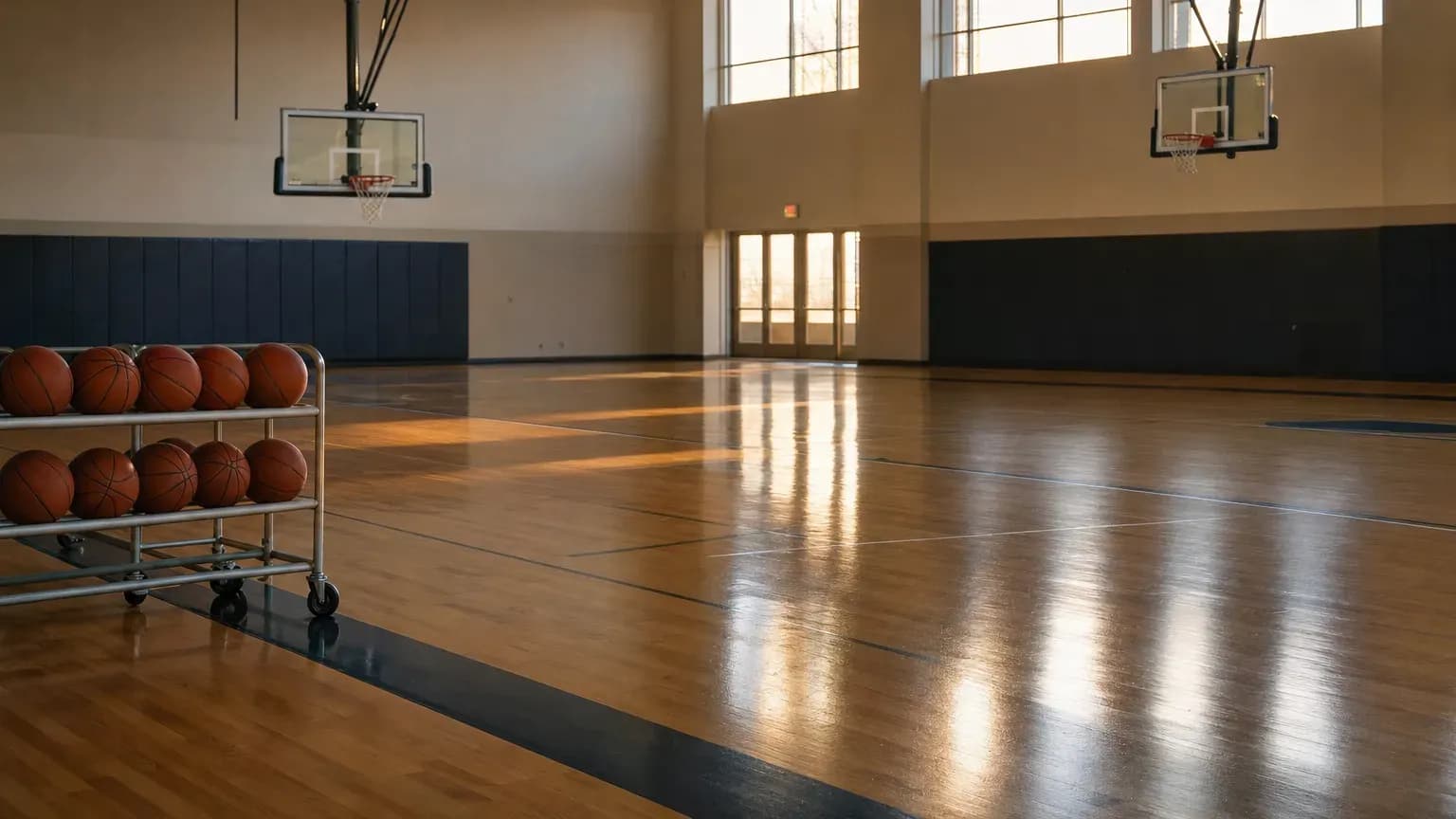
An indoor basketball court rental typically costs $25 to $125 an hour for a full court at a city recreation center, and about half that for a half court. Private indoor facilities typically charge $60 to $220 an hour. School district gyms often post $150 to $225 an hour plus a custodial fee. These ranges come from published rate pages of US city recreation departments, Ontario municipalities, school districts and private training facilities in suburban and big-city markets. What drives the price: full or half court, prime time (weeknights and weekends) versus daytime, resident or non-resident, and youth or adult use. Urban private facilities at peak cost the most.
The rest of this guide is for operators setting a rate card.
What renters typically pay
Facility type | Typical full-court rate | Typical half-court rate | Notes |
|---|---|---|---|
City recreation center, resident | $25–$125/hour | $25–$60/hour | Lower rates at small-town centers; adult and weekend rates higher |
City recreation center, non-resident | About 10–60% more than resident | Same markup | Some cities add a flat surcharge instead |
Canadian municipal gym | About CA$50–$85/hour adult prime | Lower for small gyms and youth groups | Youth (minor) rentals often heavily discounted |
School district gym | $150–$225/hour (high school at the top) | Rarely sold | Custodial fee of roughly $30–$50/hour on top, often with a 2–4 hour minimum |
Private indoor facility | $60–$220/hour | $35–$110/hour | Big-city facilities at the top of the range; off-peak discounts common |
Patterns in the published rates:
- Half court costs about half. Most facilities that split courts charge 50 to 60 percent of the full-court rate for one half.
- Weekends often cost more at city centers. Some cities charge Friday through Sunday rates 20 to 30 percent above weekday rates.
- Youth groups pay less at public facilities. Many municipalities give minor sports a lower rate. In Ontario, the gap can be large.
- Tournament use is priced separately. Some cities post a higher hourly rate for tournaments to cover extra staffing and wear.
How to set basketball court rental rates
Split the court into products
A full-size court can be sold as one full court or two half courts. If you have a two-court gym, you can sell up to four halves. Sell halves only if your curtain or divider lets two groups share without balls crossing over. Price halves at 50 to 60 percent of the full rate. That premium covers the scheduling cost of matching two halves and the chance that one half goes unsold.
Common products:
- full court, hourly
- half court, hourly
- whole gym (all courts) for tournaments and camps, by the half day or day
- party or event package, flat fee for 2–3 hours
Peak and off-peak
In basketball, demand peaks on weekday evenings, from about 5 to 10 p.m., when youth teams practice and adult leagues play. Saturday mornings and afternoons fill with games. Weekday daytime is the hardest to sell unless you have homeschool groups, schools or camps.
A practical split:
- Prime: Monday to Friday 5 p.m. to close, and Saturday to Sunday all day.
- Non-prime: Monday to Friday, opening to 5 p.m.
- Gap: non-prime at 60 to 75 percent of prime.
Youth and adult
If you're a public operator, or you want club teams as anchor customers, consider a youth rate. Club teams book the same slots every week for a whole season. That's worth a discount because it fills your calendar months ahead.
Resident and non-resident
City recreation departments almost always charge non-residents more. If you run a public facility, publish what counts as resident status for a team. Is it the majority of the roster or the person who signs the contract? Without a rule, every team will claim the resident rate.
Duration and minimums
Sell in one-hour blocks, with a one-hour minimum at prime and 90 minutes or two hours for whole-gym bookings. A half-day rate (four hours) at roughly 3.5 times the hourly rate encourages tournaments and camps to book bigger blocks.
Deposits and payment terms
Short single bookings are usually paid in full at the time of booking. Seasonal and large bookings need more structure:
- Seasonal team bookings: take a deposit of 25 to 50 percent to hold the season, with the balance invoiced monthly or before the season starts.
- Tournaments and events: take a non-refundable deposit to hold the date, plus a refundable damage deposit if outside groups bring spectators or concessions.
- Parties: pay in full at booking, with a short window for free changes.
Write down what happens to the deposit if the renter cancels, and when the balance is due. Most disputes come from groups who thought their deposit was refundable.
A worked rate card example
Here's an example for a hypothetical private facility with two full-size courts and a center divider in a mid-size metro area. It's an illustration that sits inside the ranges above.
Product | Non-prime (Mon–Fri, open–5 p.m.) | Prime (Mon–Fri 5 p.m.–close, Sat–Sun) |
|---|---|---|
Half court, 1 hour | $40 | $60 |
Full court, 1 hour | $70 | $105 |
Full court, youth club season rate (20+ weeks), 1 hour | $60 | $90 |
Whole gym (2 courts), half day (4 hours) | $480 | $720 |
Whole gym, full day (8 hours) | $880 | $1,300 |
Birthday party, 1 court + table area, 2 hours | $220 flat | $260 flat |
Ball rack or scoreboard, add-on | $15 | $15 |
To check whether this works, count your sellable court-hours. Two courts at 15 hours a day, 7 days a week, is 210 full-court hours a week (or 420 half-court hours). Model a realistic mix: most prime hours sold, a minority of non-prime hours sold. Then compare the result with your fixed costs before you commit to the numbers.
Costs your rate has to cover
- rent or mortgage and property tax
- HVAC and lighting (a gym is a large volume to heat or cool)
- floor maintenance: periodic screen-and-recoat and, less often, sanding and refinishing
- staff for opening, closing and supervising events
- general liability insurance
- equipment: backboards, rims, nets, scoreboards, divider curtain
- payment processing and booking software
If you're still planning the building, how to start an indoor sports facility walks through site selection and cost planning.
Policies that protect your rate
- Cancellation window. Many facilities let customers cancel free up to 24 to 48 hours before a single booking. Seasonal bookings usually have a longer notice period, such as 30 days.
- Overtime. Charge overtime in 30-minute increments if a group runs past its slot and keeps the next group waiting.
- Footwear and food rules. Hardwood floors are expensive to refinish. Post a no-street-shoes rule and say where food and drinks are allowed.
- Supervision for youth groups. Require a named adult in charge on every youth booking.
Running basketball court rentals with booking software
Half courts, full courts and whole-gym bookings overlap. A spreadsheet makes it easy to sell a half court that's already part of a full-court booking. Booking software built for basketball facilities prevents that.
In Sports Booking Management, each space can have its own rate, with pricing tiers by length such as hourly, half day or a flat fee. That covers the half-court, full-court and whole-gym products above. Teams book on a public booking page without an account and pay through Stripe checkout. Seasonal teams can be set up as recurring bookings and invoiced. If you want to review every request before it's confirmed, such as tournament or party enquiries, you can turn on the approvals workflow. Equipment like a ball rack can be added to a booking as an add-on.