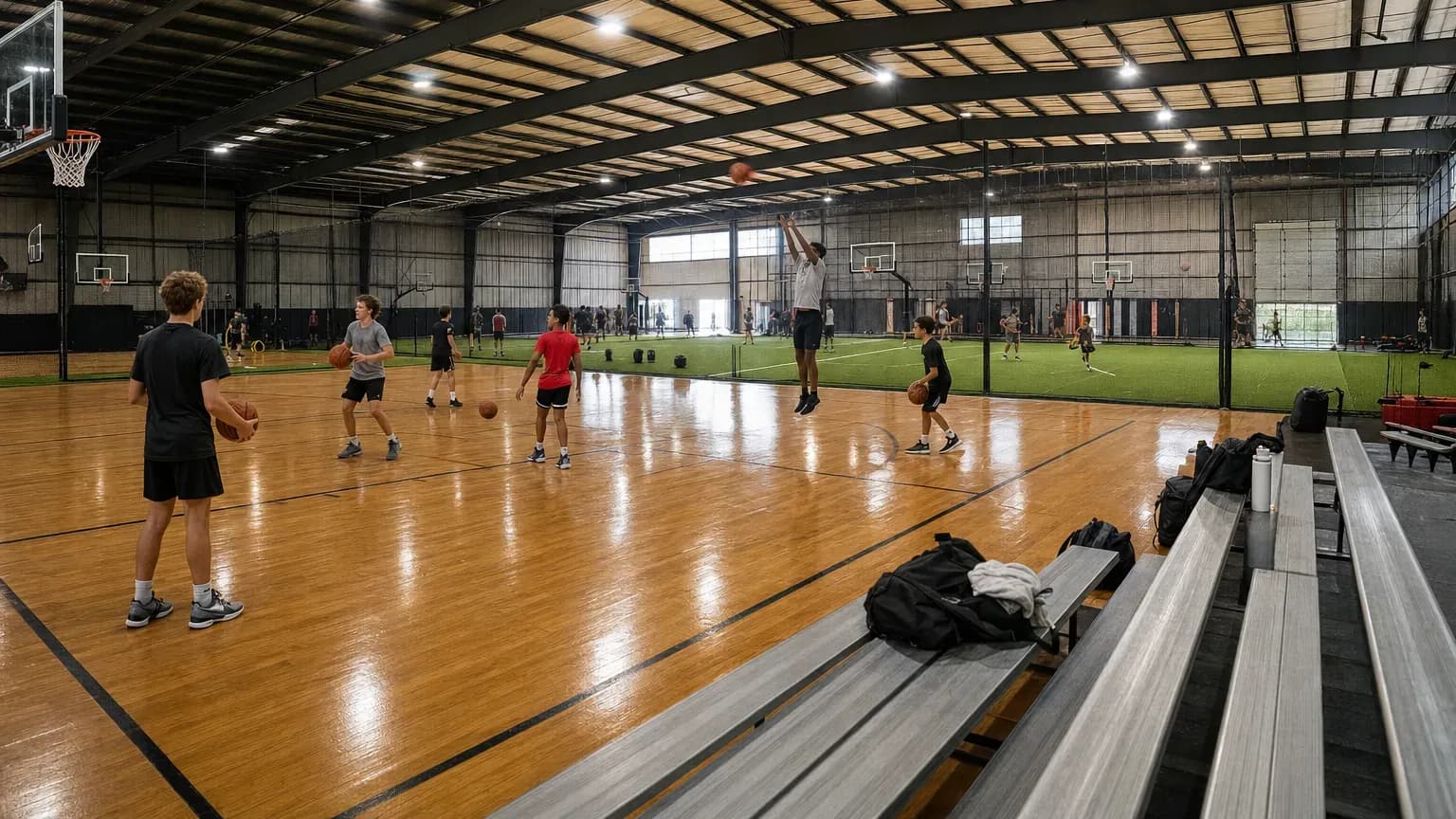
To start an indoor sports facility, you choose the sports and format, prove that local clubs and leagues will book recurring time, find a building with the clear height and open floor area those sports need, and fund a build-out that commonly runs from about $1M to $3M for a leased multi-sport conversion. Then you pre-sell seasonal blocks to clubs before you open and run the place for utilization: filling off-peak hours with camps, clinics and adult programs. The steps below cover each decision, with a startup cost table, the main revenue streams and an illustrative month of operating numbers.
Step 1: Choose the format
Most indoor facilities fit one of four formats. The format sets the building you need and the capital you have to raise.
Format | Typical spaces | Who books it | Capital needed |
|---|---|---|---|
Single-sport training center | Batting cages, a single court or a small turf area | Private lessons, teams, individual athletes | Lower |
Court facility | Two or more hardwood courts for basketball, volleyball and pickleball | Clubs, leagues, tournaments, rentals | Medium to high |
Turf facility | One or more turf areas for small-sided soccer, lacrosse and training | Clubs, adult leagues, camps | Medium to high |
Multi-sport complex | Courts plus turf, sometimes cages and a fitness area | All of the above | High |
If you want to start with racquet sports only, our guide on how to start a pickleball business covers that model in detail.
Step 2: Validate demand with real bookings
Facilities fail when the owner assumes demand instead of measuring it. Collect evidence that people will pay for recurring time:
- List every club and league within a 20 to 30 minute drive. Youth basketball, volleyball and soccer clubs are often the anchor customers, because they book the same blocks every week for a season.
- Ask where they practice now and what they pay. Many rent school gyms that are unavailable on game nights, holidays and summer weekends.
- Get letters of intent. A written commitment for a number of weekly hours is far stronger evidence than a survey.
- Map the competition. Note other facilities, their sports, their rates and which hours they sell out.
- Check the calendar. Winter or very hot summers push outdoor sports indoors and raise demand. Mild climates may make your hours more seasonal.
A rough test: if your signed or likely recurring club bookings cover your rent before you count any walk-in rentals, the idea is worth taking further.
Step 3: Find a building that fits the sports
Sports have fixed dimensions, so the building has to fit them, not the other way around. A high school basketball court is 84 by 50 feet per NFHS rules. An indoor volleyball court is 18 by 9 meters per the FIVB rules, plus free zones around it. Add run-off, team benches, spectator space, a lobby, restrooms and storage.
When you look at a building, check:
- Clear height. Volleyball and basketball need far more clearance than a typical retail unit. Confirm the requirement for your level of play with a court builder or the governing body before you sign.
- Column spacing. Columns inside a court or its run-off cost you a court or create a safety problem.
- Slab condition. Hardwood, sport tile and turf systems all need a flat, sound base.
- Zoning and occupancy. A change of use to assembly or recreation can trigger sprinklers, extra exits, accessible restrooms and parking requirements.
- HVAC and lighting. Warehouses rarely come with the heating, cooling, ventilation or light levels that sport needs.
- Parking and drop-off. Youth practices create a rush of cars at every session change.
Leasing an existing building is the usual route for a first facility. Building new gives you exactly the space you want, but adds land, design, structure and a longer timeline.
Step 4: Build a startup budget
The table below is for a leased warehouse of about 30,000 square feet converted to two hardwood courts and one turf area. It assumes a US metro area, a shell building that needs HVAC, lighting, restrooms and code work, and new sport surfaces. The figures are typical quotes and planning ranges, not bids. Your local costs could fall outside them.
Category | Typical range | Assumptions |
|---|---|---|
Lease deposit and rent during build-out | $50,000–$150,000 | Deposit plus several months of rent before opening, unless you negotiate free rent |
Build-out (HVAC, lighting, restrooms, lobby, code upgrades) | $450,000–$1,350,000 | Roughly $15–$45 per square foot of tenant improvements; the biggest variable |
Hardwood or sport tile courts | $150,000–$450,000 | Two courts, including lines; hardwood costs more than tile |
Turf area | $60,000–$200,000 | Indoor turf with pad, depending on size and product |
Equipment (hoops, volleyball systems, nets, goals, divider netting) | $60,000–$200,000 | Ceiling-mounted hoops and divider curtains are at the high end |
Furniture, front desk and retail | $25,000–$75,000 | Seating, check-in, opening stock |
Technology | $10,000–$30,000 | Booking software, Wi-Fi, cameras, scoreboards |
Professional fees and permits | $40,000–$150,000 | Architect, engineer, attorney, accountant, permit fees |
Pre-opening marketing | $15,000–$50,000 | Signage, website, launch events |
Working capital | $100,000–$300,000 | Three to six months of operating costs while bookings grow |
Total | About $0.96M–$2.95M |
|
If you build new instead, builder guides commonly quote total construction from about $100 to $300 or more per square foot of building, before land. Hold a contingency of at least 10% on any construction budget.
Step 5: Stack your revenue streams
Hourly rentals alone rarely carry an indoor facility. Most operators combine several sources:
- Seasonal club rentals. Recurring weekly blocks sold to youth and adult clubs for a season, usually invoiced in advance or in installments.
- Hourly rentals for teams, groups and individuals, with peak and off-peak rates.
- In-house leagues for adults and youth, sold per team or per player.
- Camps and clinics in school breaks and summer, which fill weekday daytime hours.
- Tournaments and showcases on weekends, with team entry fees and spectator admission.
- Lessons and training by staff or contracted coaches, with the facility keeping a share.
- Birthday parties and corporate events.
- Food, drink and retail, from vending to a concession stand.
- Sponsorship and advertising, such as court naming and banner space.
The mix matters more than any single price. Clubs give you predictable evening income. Camps and daytime programs decide whether the building earns anything between 9 a.m. and 3 p.m.
Step 6: Run the numbers on one month
Here is an illustrative monthly model for the facility above. Every number is an assumption chosen to show how the math works. None of them are benchmarks.
Assumptions:
- 3 rentable spaces (2 courts, 1 turf area), open 14 hours a day, 30 days a month = 1,260 space-hours available
- 45% blended utilization = 567 booked space-hours
- $85 average yield per booked space-hour, blending club blocks, hourly rentals and league time
- $20,000 a month from camps, tournaments, parties and concessions combined
- Costs exclude loan payments and the owner's salary
Line | Monthly amount |
|---|---|
Space revenue (567 × $85) | $48,195 |
Programs and other revenue | $20,000 |
Total revenue | $68,195 |
Rent, including taxes and common charges | $27,500 |
Staff (manager, front desk, program staff) | $17,000 |
Utilities | $6,500 |
Insurance | $2,500 |
Maintenance, cleaning and supplies | $3,500 |
Marketing | $2,500 |
Payment processing and software | $2,500 |
Total costs | $62,000 |
Operating profit before debt service | $6,195 |
Change only utilization and the picture moves quickly:
Utilization | Space revenue | Total revenue | Operating result |
|---|---|---|---|
35% | $37,485 | $57,485 | −$4,515 |
45% | $48,195 | $68,195 | $6,195 |
55% | $58,905 | $78,905 | $16,905 |
65% | $69,615 | $89,615 | $27,615 |
In this example, each 10 points of utilization moves the result by about $10,700 a month. Rebuild the table with your own rent, rates and hours before you commit. Our sports facility business plan guide shows how to turn this into a full multi-year projection.
Step 7: Set up the legal and financial basics
- Entity, tax number and bank account. Form an LLC or corporation and get an EIN in the US or a business number in Canada.
- Insurance. Plan for general liability that covers participants, property coverage for the build-out and equipment, workers' compensation once you have employees, and abuse and molestation coverage if you host youth programs. Our sports facility insurance guide explains each coverage.
- Waivers and rental agreements. Every renter and participant should sign a waiver, and every club should sign a rental agreement that names them as responsible for their own players. Have a local attorney review both.
- Financing. First facilities are usually funded with owner equity, a bank or SBA-backed loan in the US, equipment financing and pre-sold club contracts.
- Lease terms. Negotiate free rent during build-out, a tenant improvement allowance and renewal options long enough to repay your investment.
Step 8: Pre-sell before you open
- Sign seasonal contracts with anchor clubs and take deposits.
- Schedule your first league seasons and summer camps and open registration early.
- Book opening tournaments with local organizers.
- Run a launch weekend with free open gym and demo sessions.
Step 9: Operate for utilization
Track utilization by space and hour block, revenue per available space-hour, and cancellations every week. Sell prime evenings to clubs on seasonal contracts, push daytime hours to camps, schools, homeschool programs and adult leagues, and publish a clear cancellation policy so late drop-outs don't leave courts empty and unpaid.
How to run bookings with booking software
A multi-sport building has many spaces, renters and rate types, which is hard to manage from a shared spreadsheet. Sports Booking Management lets you set up each court and turf area as its own space with its own hours and booking rules, and price by the hour, half day or flat fee with different rates per space. Recurring bookings handle seasonal club blocks, the optional approval workflow lets you review requests before they're confirmed, and renters book and pay through Stripe checkout from a public booking page without making an account. Invoices cover clubs that pay by term. It's one plan at $79/month with unlimited venues and bookings. See how it fits a multi-sport facility.