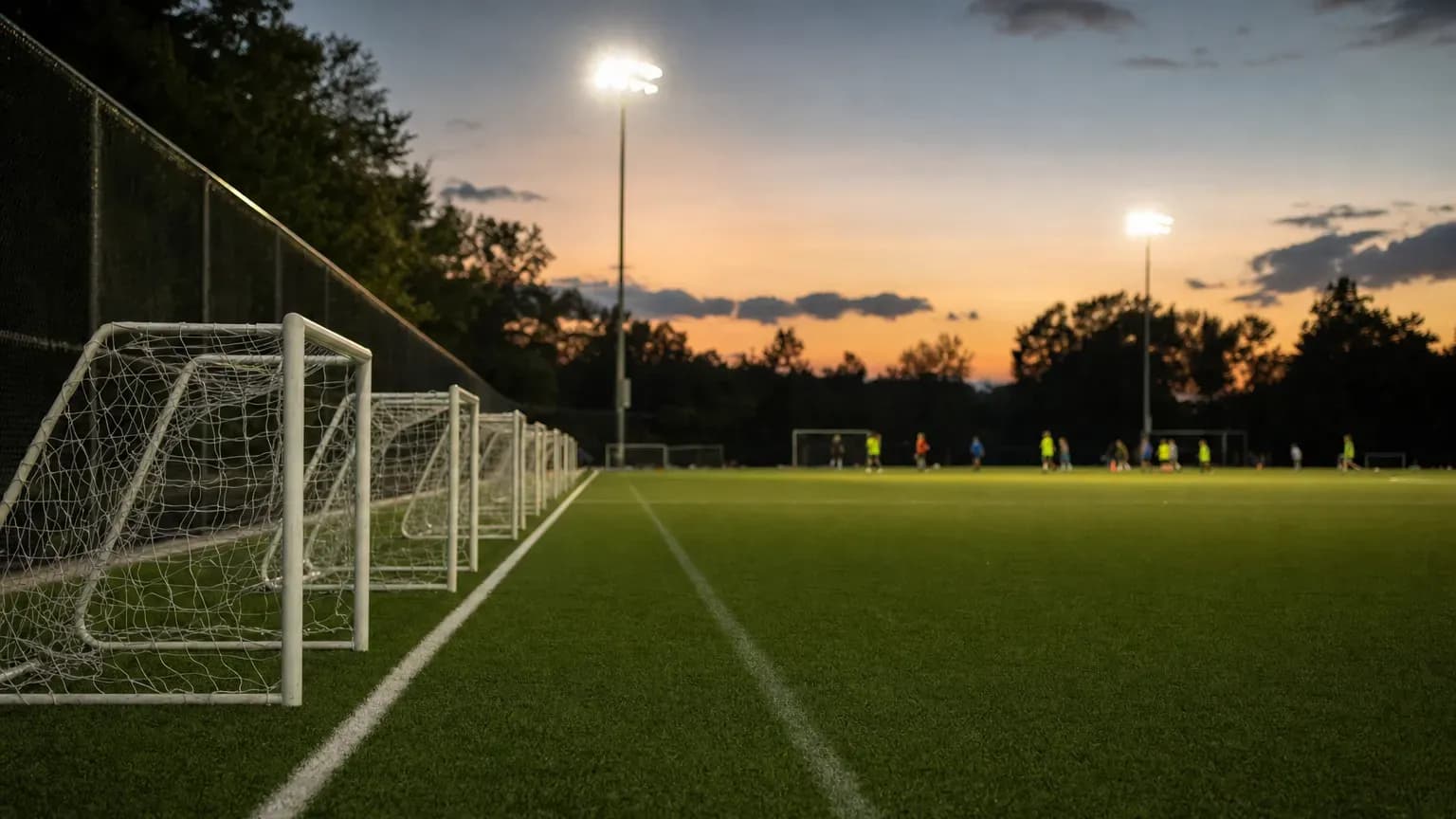
A soccer field rental typically costs $20 to $75 an hour for a grass field at a US city park and $65 to $90 an hour for a synthetic turf field, plus a lights fee of $5 to $30 an hour after dark. Youth groups and residents pay less, and some cities charge youth residents under $10 an hour. A full indoor dome field typically runs $240 to $400 an hour, with half fields about 55 to 65 percent of that. In Canada, city turf fields typically cost CA$30 to CA$160 an hour for adults. These ranges come from published rate pages of US parks departments in the Northwest, Southwest and Midwest, Midwest indoor domes, and cities in British Columbia, Alberta and Ontario.
The rest of this guide is for field operators building a rate card.
What renters typically pay
These are typical quotes from public rate pages for one field for one hour. They aren't averages, and lights are usually extra.
Facility type | Typical hourly rate | Notes |
|---|---|---|
US city grass field, youth resident | About $6–$20 | Some cities price youth play near cost |
US city grass field, adult | About $17–$75 | Non-resident rates often 20 to 50 percent higher |
US city synthetic turf field | About $65–$90 | Resident vs. non-resident; premium turf at the top |
Lights add-on | About $5–$30 per hour | Charged per hour of lit use |
US indoor dome, full field, prime | About $340–$395 | Weekday evenings and weekend days |
US indoor dome, full field, off-peak or holiday | About $240–$340 | Daytime and some weekend evenings |
US indoor dome, half field | About $155–$215 | Common for youth practices |
Canadian city turf field, minor | About CA$17–$127 | Wide range: coastal BC at the low end, Alberta at the top |
Canadian city turf field, adult | About CA$30–$160 | Some cities have separate prime and non-prime rates |
Patterns in the published rates:
- Residents and youth pay far less. At the low end, youth resident rates are a fraction of the adult non-resident rate for the same field.
- Lights are priced separately. Most parks departments add an hourly lights fee rather than building it into the field rate.
- Turf costs more than grass. Turf carries more of a field's bookings because it drains fast and doesn't need rest, so cities price it higher.
- Indoor domes sell partial fields. Half-field rentals are standard, and they're how youth clubs afford winter training.
- Some cities split prime and non-prime. One BC city charges about half its prime rate for weekday daytime turf.
How to set soccer field rental rates
Split the field into products
A full-size field can usually be sold whole or in parts. Per the IFAB Laws of the Game, a full-size field is 100 to 130 yards long and 50 to 100 yards wide. Youth small-sided fields are much smaller, so one big field can host several youth practices or games at once.
Common products:
- Full field: adult games, 11v11 youth games and full-team practices
- Half field: youth practices, 7v7 or 9v9 games
- Quarter field or small-sided area: young age groups, small-group training
- Whole complex: tournaments and camps, by the day or weekend
Price halves at 55 to 65 percent of the full field and quarters at 30 to 35 percent. The premium covers the risk of an unsold section. Only sell sections you can mark out clearly with cones, lines or a divider net.
Peak and off-peak
Field demand follows school and work. Weekday evenings from about 5 to 9 p.m. and weekend days are prime, and outdoors that often means lit hours. Weekday daytime is hard to fill outside summer camps, school use and adult daytime leagues.
A practical split:
- Prime: weekdays from 5 p.m. to close, weekends all day.
- Off-peak: weekdays before 5 p.m.
- Gap: off-peak at 50 to 75 percent of prime.
Lights
Either charge lights as a separate hourly fee or publish a lit rate that includes them. Separate fees make your costs visible to renters. An all-in lit rate is simpler at the front desk. Either way, set a rule for who turns lights on and off, and charge for the full lit hour so you're not haggling over 20 minutes of light.
Youth, adult and resident tiers
Public operators commonly price by:
- youth nonprofit or affiliated clubs (lowest)
- adult recreational
- non-resident
- for-profit or commercial (camps, academies, private trainers)
Private operators usually skip resident tiers but give clubs a contract rate for booking a whole season. A club holding Tuesday and Thursday evenings from September to November is worth a discount, because it fills those hours months ahead.
Duration and minimums
Sell in 60- or 90-minute blocks. Many adult games and youth practices run 90 minutes, so offering that block avoids awkward 30-minute gaps. For tournaments, use full-day or weekend rates with a minimum number of fields.
Deposits, rainouts and cancellations
Outdoor fields have a problem that courts and rinks don't: weather. Your policy needs to cover both renter cancellations and field closures.
- Field closed by the operator: credit or refund the booking. Say who decides and how renters will be told, such as an email or a field status page.
- Field open, renter cancels: treat it as a regular cancellation under your normal notice period.
- Seasonal bookings: take a 25 to 50 percent deposit to hold the season, and invoice the balance monthly or before the season starts.
- Tournaments: take a non-refundable deposit to hold the date, plus a damage deposit if spectators, tents or vendors are involved.
Our court booking cancellation policy template adapts easily to fields: add a weather clause and a field-closure clause.
A worked rate card example
Here's an example for a hypothetical private complex with two lighted outdoor turf fields in a mid-size US market. Each field can be split into halves. It's an illustration within the ranges above, not a recommendation for your market.
Product | Off-peak (Mon–Fri before 5 p.m.) | Prime (Mon–Fri 5 p.m.–close, Sat–Sun) |
|---|---|---|
Full field, 1 hour, lights included | $60 | $95 |
Full field, 90 minutes, lights included | $90 | $140 |
Half field, 1 hour, lights included | $35 | $55 |
Full field, youth club season contract (12+ weeks), 1 hour | $55 | $85 |
Tournament, both fields, full day (8 hours) | — | $1,300 |
Ball and pinnie rental, add-on | $10 | $10 |
Portable goals moved or set up, add-on | $20 | $20 |
Check the card against your hours. Say two fields are open 14 hours a day in season. That's 196 full-field hours a week, or twice that in halves. Count how many hours fall in prime. Estimate the share you'll fill from contracts you already have, then compare the result with your turf replacement fund, lighting, staff and insurance.
Costs your rates have to cover
- turf replacement fund, set aside every month (synthetic turf wears out and needs replacing)
- grass maintenance: mowing, irrigation, fertilizer, line painting and rest periods
- field lighting electricity and lamp or fixture repairs
- goals, nets, corner flags and anchors
- staff for opening, closing and field checks
- liability insurance, and a requirement that leagues and clubs show their own coverage
- for domes: inflation, heating and snow management in winter
- payment processing and booking software
Running field rentals with booking software
Fields are booked in a mix of full fields, halves and whole-complex blocks, by clubs that want the same slots every week. A booking system built for soccer facilities keeps that schedule in one place.
In Sports Booking Management, each field, or each half you sell separately, can be its own space with its own operating hours, booking rules and rates. Pricing tiers by length cover hourly, 90-minute, half-day and flat-fee tournament bookings. Clubs can be set up as recurring bookings and invoiced, while pickup groups and one-off renters book on a public booking page without an account and pay through Stripe checkout. Turn on approvals if you want to vet tournament and camp requests, and add ball or pinnie rental as an add-on. The plan is $79 a month with unlimited venues and bookings. See pricing for details.