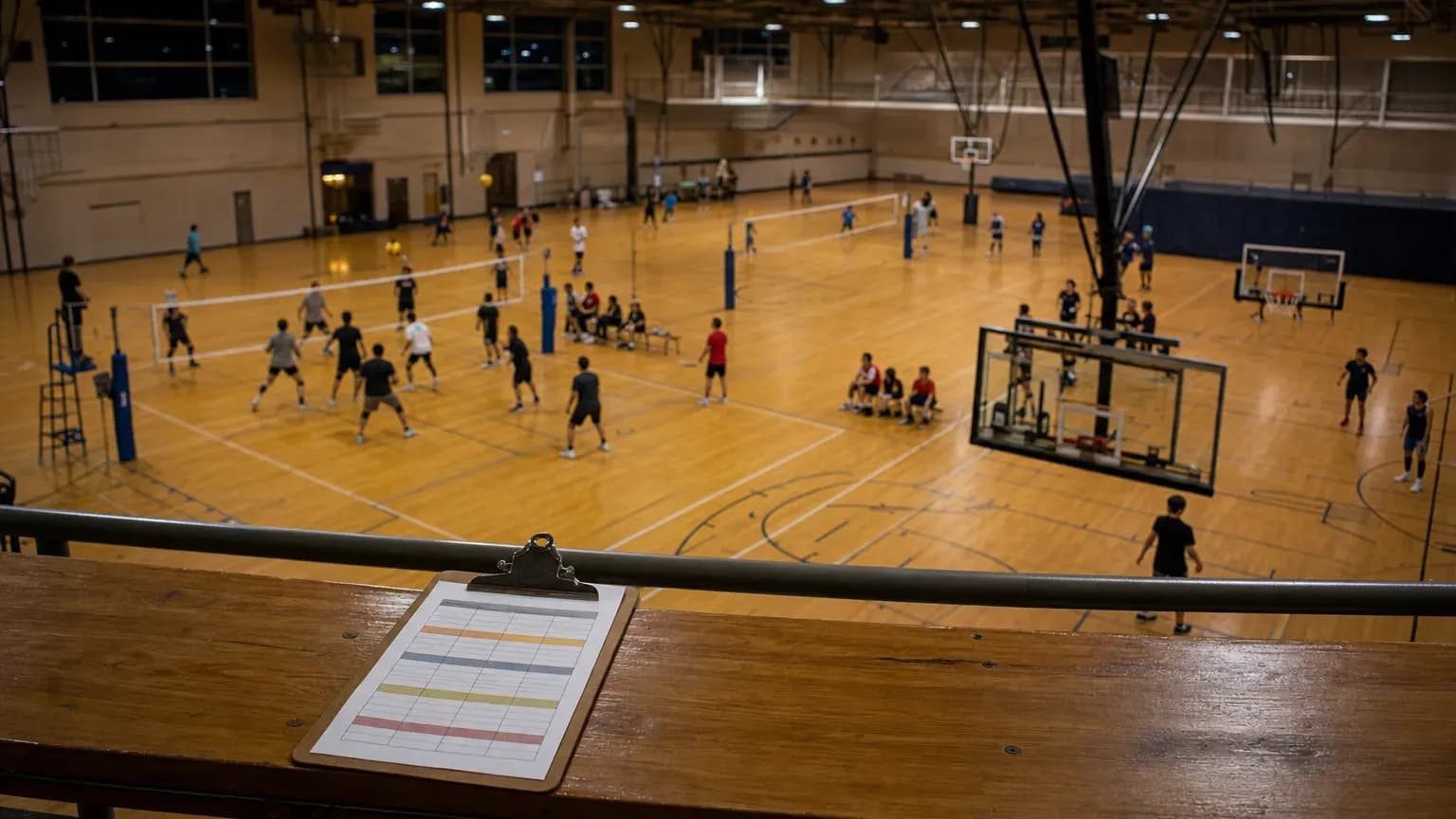
An 8 team round robin has 28 games over 7 rounds, with 4 games per round and every team playing each other team exactly once. Round 1 is 1 vs 8, 2 vs 7, 3 vs 6 and 4 vs 5. The full 8 team table is below, along with complete tables for 4, 5, 6, 7, 10 and 12 teams, where odd counts use a bye. Every table was generated with the circle method and checked so that each pair meets exactly once and no team plays twice in a round.
After the tables, this guide covers how to build a schedule yourself, double round robins, and how to spread games across courts and time slots so no team always gets the bad court or the late game.
How many rounds and games you need
For n teams in a single round robin:
- Total games: n × (n − 1) ÷ 2
- Games per team: n − 1
- Rounds: n − 1 if n is even; n if n is odd (each team gets one bye)
- Games per round: n ÷ 2, rounded down
Teams | Rounds | Games per round | Total games | Byes per team | Double round robin games |
|---|---|---|---|---|---|
4 | 3 | 2 | 6 | 0 | 12 |
5 | 5 | 2 | 10 | 1 | 20 |
6 | 5 | 3 | 15 | 0 | 30 |
7 | 7 | 3 | 21 | 1 | 42 |
8 | 7 | 4 | 28 | 0 | 56 |
10 | 9 | 5 | 45 | 0 | 90 |
12 | 11 | 6 | 66 | 0 | 132 |
Games per round is also the number of courts or fields you need to play a whole round in one time slot.
The 8 team round robin schedule
Number your teams 1 to 8 by random draw, then play down the table one round per week (or per session). The order within a game is arbitrary; it does not mean home and away.
Round | Game 1 | Game 2 | Game 3 | Game 4 |
|---|---|---|---|---|
1 | 1 vs 8 | 2 vs 7 | 3 vs 6 | 4 vs 5 |
2 | 7 vs 1 | 8 vs 6 | 2 vs 5 | 3 vs 4 |
3 | 1 vs 6 | 7 vs 5 | 8 vs 4 | 2 vs 3 |
4 | 5 vs 1 | 6 vs 4 | 7 vs 3 | 8 vs 2 |
5 | 1 vs 4 | 5 vs 3 | 6 vs 2 | 7 vs 8 |
6 | 3 vs 1 | 4 vs 2 | 5 vs 8 | 6 vs 7 |
7 | 1 vs 2 | 3 vs 8 | 4 vs 7 | 5 vs 6 |
A version with court assignments balanced for every team is in the court rotation section further down.
How the circle method works
The circle method (sometimes called the polygon or Berger method) is how almost every round robin generator builds its schedule. You can do it by hand with a sheet of paper.
- Write the teams in two rows. For 8 teams, the top row is 1, 2, 3, 4 and the bottom row is 8, 7, 6, 5.
- Pair each column. That gives round 1: 1 vs 8, 2 vs 7, 3 vs 6, 4 vs 5.
- Fix team 1 in place and rotate everyone else one spot clockwise. Team 8 moves up next to team 1, the top row shifts right, and team 4 drops to the bottom row. The new rows are 1, 8, 2, 3 on top and 7, 6, 5, 4 below.
- Pair the columns again. Round 2 is 1 vs 7, 8 vs 6, 2 vs 5, 3 vs 4.
- Repeat until you are back where you started. With 8 teams that takes 7 rotations, so 7 rounds.
Because one team stays still while the other seven cycle past it, every team lines up opposite every other team exactly once.
Odd number of teams: add a dummy team called "Bye" so the count is even, then run the same method. Whoever draws the bye sits out that round. With 7 teams you schedule 8 "teams," so you get 7 rounds, and each real team sits out once.
Round robin tables for 4 to 12 teams
4 teams (3 rounds, 6 games)
Round | Game 1 | Game 2 |
|---|---|---|
1 | 1 vs 4 | 2 vs 3 |
2 | 3 vs 1 | 4 vs 2 |
3 | 1 vs 2 | 3 vs 4 |
5 teams (5 rounds, 10 games, one bye per round)
Round | Game 1 | Game 2 | Bye |
|---|---|---|---|
1 | 2 vs 5 | 3 vs 4 | 1 |
2 | 5 vs 1 | 2 vs 3 | 4 |
3 | 1 vs 4 | 5 vs 3 | 2 |
4 | 3 vs 1 | 4 vs 2 | 5 |
5 | 1 vs 2 | 4 vs 5 | 3 |
6 teams (5 rounds, 15 games)
Round | Game 1 | Game 2 | Game 3 |
|---|---|---|---|
1 | 1 vs 6 | 2 vs 5 | 3 vs 4 |
2 | 5 vs 1 | 6 vs 4 | 2 vs 3 |
3 | 1 vs 4 | 5 vs 3 | 6 vs 2 |
4 | 3 vs 1 | 4 vs 2 | 5 vs 6 |
5 | 1 vs 2 | 3 vs 6 | 4 vs 5 |
7 teams (7 rounds, 21 games, one bye per round)
Round | Game 1 | Game 2 | Game 3 | Bye |
|---|---|---|---|---|
1 | 2 vs 7 | 3 vs 6 | 4 vs 5 | 1 |
2 | 7 vs 1 | 2 vs 5 | 3 vs 4 | 6 |
3 | 1 vs 6 | 7 vs 5 | 2 vs 3 | 4 |
4 | 5 vs 1 | 6 vs 4 | 7 vs 3 | 2 |
5 | 1 vs 4 | 5 vs 3 | 6 vs 2 | 7 |
6 | 3 vs 1 | 4 vs 2 | 6 vs 7 | 5 |
7 | 1 vs 2 | 4 vs 7 | 5 vs 6 | 3 |
10 teams (9 rounds, 45 games)
Round | Game 1 | Game 2 | Game 3 | Game 4 | Game 5 |
|---|---|---|---|---|---|
1 | 1 vs 10 | 2 vs 9 | 3 vs 8 | 4 vs 7 | 5 vs 6 |
2 | 9 vs 1 | 10 vs 8 | 2 vs 7 | 3 vs 6 | 4 vs 5 |
3 | 1 vs 8 | 9 vs 7 | 10 vs 6 | 2 vs 5 | 3 vs 4 |
4 | 7 vs 1 | 8 vs 6 | 9 vs 5 | 10 vs 4 | 2 vs 3 |
5 | 1 vs 6 | 7 vs 5 | 8 vs 4 | 9 vs 3 | 10 vs 2 |
6 | 5 vs 1 | 6 vs 4 | 7 vs 3 | 8 vs 2 | 9 vs 10 |
7 | 1 vs 4 | 5 vs 3 | 6 vs 2 | 7 vs 10 | 8 vs 9 |
8 | 3 vs 1 | 4 vs 2 | 5 vs 10 | 6 vs 9 | 7 vs 8 |
9 | 1 vs 2 | 3 vs 10 | 4 vs 9 | 5 vs 8 | 6 vs 7 |
12 teams (11 rounds, 66 games)
Round | Game 1 | Game 2 | Game 3 | Game 4 | Game 5 | Game 6 |
|---|---|---|---|---|---|---|
1 | 1 vs 12 | 2 vs 11 | 3 vs 10 | 4 vs 9 | 5 vs 8 | 6 vs 7 |
2 | 11 vs 1 | 12 vs 10 | 2 vs 9 | 3 vs 8 | 4 vs 7 | 5 vs 6 |
3 | 1 vs 10 | 11 vs 9 | 12 vs 8 | 2 vs 7 | 3 vs 6 | 4 vs 5 |
4 | 9 vs 1 | 10 vs 8 | 11 vs 7 | 12 vs 6 | 2 vs 5 | 3 vs 4 |
5 | 1 vs 8 | 9 vs 7 | 10 vs 6 | 11 vs 5 | 12 vs 4 | 2 vs 3 |
6 | 7 vs 1 | 8 vs 6 | 9 vs 5 | 10 vs 4 | 11 vs 3 | 12 vs 2 |
7 | 1 vs 6 | 7 vs 5 | 8 vs 4 | 9 vs 3 | 10 vs 2 | 11 vs 12 |
8 | 5 vs 1 | 6 vs 4 | 7 vs 3 | 8 vs 2 | 9 vs 12 | 10 vs 11 |
9 | 1 vs 4 | 5 vs 3 | 6 vs 2 | 7 vs 12 | 8 vs 11 | 9 vs 10 |
10 | 3 vs 1 | 4 vs 2 | 5 vs 12 | 6 vs 11 | 7 vs 10 | 8 vs 9 |
11 | 1 vs 2 | 3 vs 12 | 4 vs 11 | 5 vs 10 | 6 vs 9 | 7 vs 8 |
9 or 11 teams: use the 10 or 12 team table and treat the highest number as the bye. For 9 teams, whoever is drawn against team 10 sits out; for 11 teams, whoever is drawn against team 12 sits out.
Double round robins
A double round robin has every pair meet twice. The simplest way to build one:
- Play the single round robin table from top to bottom.
- Play it again, swapping the order of each pairing if you track home and away, serve, or first possession.
For 8 teams that is 14 rounds and 56 games, with each team playing 14 games. That is a common shape for a fall or winter league that runs about 14 weeks.
Two adjustments are worth making:
- Don't replay round 7 as round 8. If you run the second half in the same order, round 7 and round 8 are different matchups, so there's no back-to-back rematch. If you reverse the second half instead (start from round 7), round 7 and round 8 would be the same games. Keep the original order.
- Reshuffle team numbers for the second half if teams care about the order. Randomly reassigning numbers before the second pass changes when each rematch lands, which helps if strong teams happened to meet each other in the final weeks of the first pass.
If you only have time for one and a half rounds, play the full single round robin and then seed a short playoff from the standings rather than a partial second pass, which would give some teams more games against strong opponents than others.
Spreading games fairly across courts and time slots
A round robin settles who plays whom. It doesn't settle where or when. If you simply put "Game 1" on Court 1 every week, team 1 plays every game on Court 1, which matters when one court has a dead spot, worse lighting, or sits next to the entrance.
Here is the same 8 team schedule with games placed so every team plays on each of the 4 courts either once or twice across the 7 rounds. That is as even as 7 games across 4 courts can be.
Round | Court 1 | Court 2 | Court 3 | Court 4 |
|---|---|---|---|---|
1 | 4 vs 5 | 1 vs 8 | 3 vs 6 | 2 vs 7 |
2 | 7 vs 1 | 2 vs 5 | 3 vs 4 | 8 vs 6 |
3 | 1 vs 6 | 2 vs 3 | 7 vs 5 | 8 vs 4 |
4 | 8 vs 2 | 7 vs 3 | 6 vs 4 | 5 vs 1 |
5 | 5 vs 3 | 1 vs 4 | 7 vs 8 | 6 vs 2 |
6 | 4 vs 2 | 6 vs 7 | 5 vs 8 | 3 vs 1 |
7 | 3 vs 8 | 5 vs 6 | 1 vs 2 | 4 vs 7 |
If you have fewer courts than games per round, split each round into time slots. Eight teams on 2 courts means two slots per night, for example 7:00 and 8:00. Treat the slot the same way you treat the court: count how many early and late games each team gets and swap games between slots until each team is within one of even. With 7 rounds, the best you can do is 4 early and 3 late (or the reverse) for each team.
A quick fairness checklist before you publish a schedule:
- Every team plays every other team the planned number of times.
- No team plays twice in the same round.
- Each team's count on each court differs by no more than one.
- Each team's early versus late games differ by no more than one.
- Byes (odd counts) are spread out, not bunched in the first or last week.
- Holiday weeks and blackout dates are removed before you assign rounds to dates, not after.
Worked example: court time for an 8 team league
Say you run an 8 team adult volleyball league on two courts, one hour per match, single round robin plus a one-night playoff.
Item | Calculation | Result |
|---|---|---|
Regular season games | 8 × 7 ÷ 2 | 28 games |
Games per night | 4 games, 2 courts | 2 one-hour slots |
Regular season nights | 7 rounds | 7 nights |
Court-hours, regular season | 28 games × 1 hour | 28 court-hours |
Playoff (top 4, semis and final) | 3 games | 2 nights or 1 long night |
Total court-hours to block | 28 + 3 | 31 court-hours |
Those 31 court-hours are what you take out of your public rental inventory for the season. If you also rent courts by the hour, that is the number to weigh against what those slots would earn as open bookings. Our guide on how to start an indoor sports facility covers how leagues and rentals fit together in a facility's weekly calendar.
Tiebreakers to publish with the schedule
Settle tiebreakers before the first game, not after. A common order for a round robin:
- Head-to-head result between the tied teams
- Point, goal or set differential
- Points or goals allowed (fewest wins)
- Coin toss or a one-game playoff
With three or more teams tied, apply head-to-head only among the tied teams, and only if they all played each other the same number of times.
Running a round robin league with booking software
Once the matchups are set, the work is in the calendar: reserving the right courts every week, keeping those slots away from public renters, and moving games when a holiday or tournament lands on a league night. In Sports Booking Management, you can set up the league's court time as recurring bookings on each space, so the slots are blocked for the whole season, and public renters see only what is left on your booking page. The calendar's week view shows which courts are held for league play on any given night. The software doesn't generate round robin pairings or standings, so use the tables above for the matchups and the booking calendar for the court time.
If you're comparing tools for this, the sports facility scheduling software page explains what to look for.