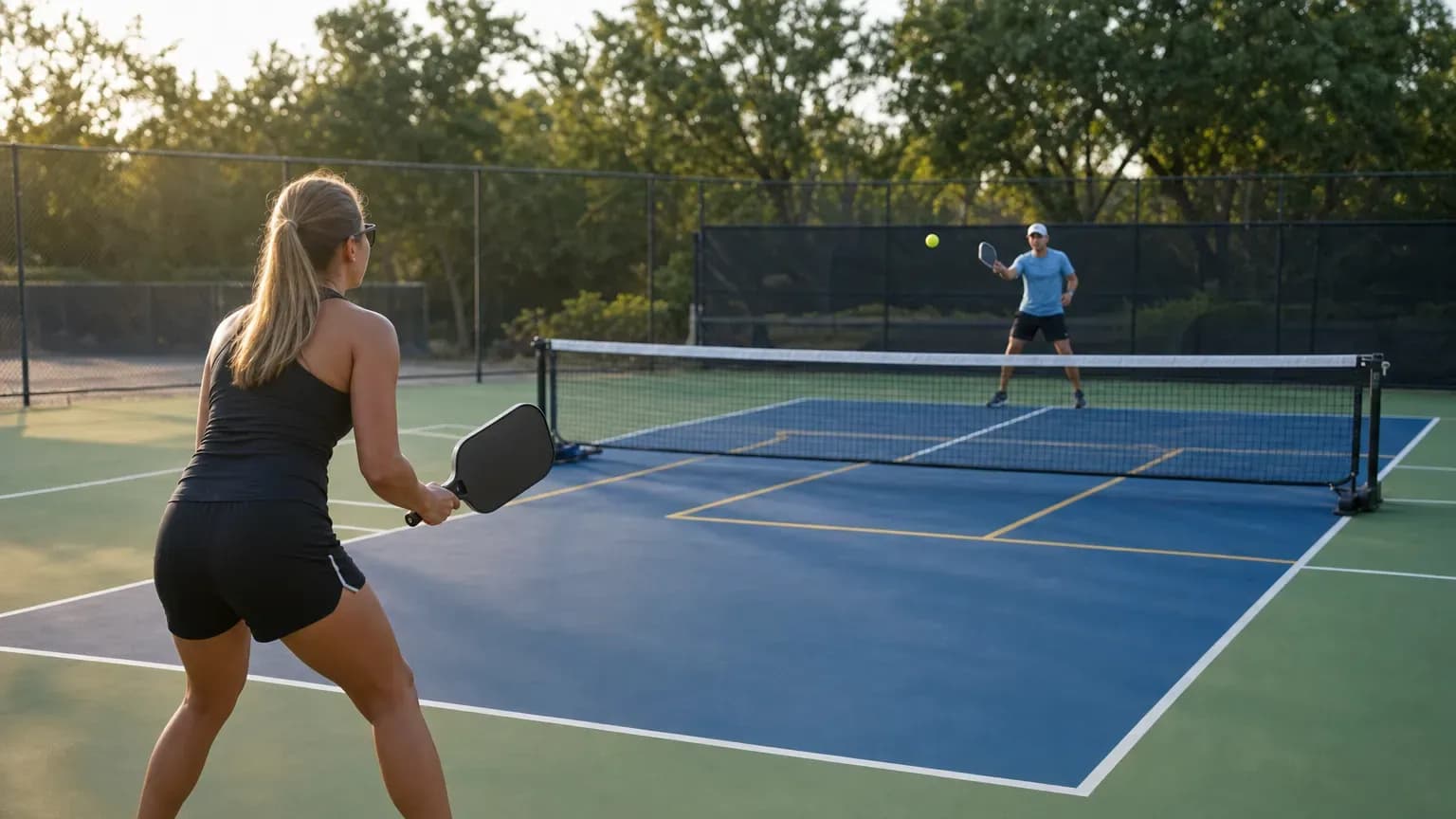
Yes, you can play pickleball on a tennis court. A pickleball court is 20 × 44 feet, per the USA Pickleball rulebook, and fits easily inside a 36 × 78 foot doubles tennis court. You can tape temporary lines and bring a portable net, paint permanent "blended" pickleball lines alongside the tennis lines, or play across the tennis net after lowering it to 34 inches at center. If you're willing to give up tennis, a standard 60 × 120 foot tennis enclosure converts to four dedicated pickleball courts.
Below are the differences between the two courts, each setup option, and how facilities share one court between two sports without fights over court time.
Tennis court vs pickleball court
The numbers below come from the ITF Rules of Tennis and the 2026 USA Pickleball Official Rulebook.
| Tennis (doubles) | Pickleball |
|---|---|---|
Court size | 78 × 36 ft (23.77 × 10.97 m) | 44 × 20 ft (13.41 × 6.10 m) |
Singles width | 27 ft (8.23 m) | Same court for singles and doubles |
Net height at center | 36 in (0.914 m) | 34 in |
Net height at posts or sidelines | 42 in (1.07 m) at the posts | 36 in at the sidelines |
Service line or kitchen line | Service line 21 ft from the net | Non-volley zone line 7 ft from the net |
Space around the court | ITF recommends 21 ft behind each baseline and 12 ft beside each sideline | 30 × 60 ft minimum playing surface |
Typical enclosure | About 60 × 120 ft | Four courts fit in that enclosure |
An acrylic hard court, the most common tennis surface in the US, works well for pickleball. On clay or grass, test the bounce first, because the plastic ball behaves very differently from a tennis ball on soft surfaces.
Option 1: Temporary lines and a portable net
This is the quickest and cheapest setup, and it's how most people try pickleball on a tennis court for the first time.
How to do it:
- Pick a spot on one half of the tennis court, away from the tennis net.
- Measure a 20 × 44 foot rectangle. Mark the net line across the middle, then the two non-volley zone lines 7 feet either side of it.
- Mark the centerline from each kitchen line back to the baseline.
- Use court tape, chalk or flat throw-down lines. Tape should be removed after play so it doesn't lift the surface.
- Set up a portable pickleball net on the net line, checking that it's 34 inches at center and 36 inches at the sidelines.
Many portable nets are the right length for a regulation court, and two fit on one tennis court if you place a court on each side of the tennis net.
Option 2: Play across the tennis net
You can also center a pickleball court on the tennis net and use the net that's already there.
The geometry works out neatly. A pickleball court is 44 feet long, so each baseline sits 22 feet from the net. The tennis service line is 21 feet from the net, so the pickleball baseline lands just 1 foot behind it. The pickleball sidelines sit 10 feet either side of the center service line, inside the 27 foot tennis singles court.
The net is the catch. A tennis net is 36 inches at center and 42 inches at the posts. Use the center strap to drop the center to 34 inches. Because the tennis posts stand well outside the pickleball sidelines, the net will still be a little higher than 36 inches where it crosses the pickleball sidelines. It's fine for recreational games, but not for sanctioned play.
Option 3: Blended lines
Blended lines are permanent pickleball lines painted on the tennis court in a different color from the tennis lines. Players bring portable nets or the facility stores them courtside.
Pros:
- The court stays fully usable for tennis.
- Pickleball players don't have to measure or tape anything.
- Adding blended lines is cheap compared with a full conversion, especially when done during a scheduled resurfacing.
Cons:
- Extra lines can distract some tennis players, especially in competitive play.
- Portable nets need to be set up, taken down and stored.
- Only one sport can use the court at a time, so you need a schedule.
The USA Pickleball rulebook asks that pickleball lines all be one color and contrast with the playing surface. On a blended court, choosing a color that also differs from the white tennis lines makes the layout easy to read.
Option 4: Convert to four dedicated pickleball courts
A full conversion takes the tennis net and posts out, resurfaces the court and installs four pickleball courts with permanent net posts. Each court gets the 30 × 60 foot minimum playing surface from the USA Pickleball rulebook. That's the only way four courts fit, because the rulebook's recommended 34 × 64 feet per court won't allow four in a 60 × 120 enclosure. See our pickleball court dimensions guide for a full space-planning table.
Most operators add divider netting between the four courts, and many put in a center fence or curtain to stop balls rolling across.
Comparing the options
Costs here are typical US ranges for an existing hard court in good condition. They aren't quotes. Resurfacing, crack repair, posts set in concrete and lighting changes can push costs much higher.
Option | Pickleball courts | Tennis still playable? | Typical cost | Best for |
|---|---|---|---|---|
Tape lines and portable net | 1–2 | Yes | Tape and chalk are cheap; regulation portable nets often run a few hundred dollars each | Trying it out, pop-up sessions |
Across the tennis net | 1 | Yes | Little or nothing | Casual play with what's already there |
Blended lines | 1–2 | Yes | Line painting is often a few hundred to a few thousand dollars per court, less if done during a resurfacing | Clubs and parks with steady demand for both sports |
Full conversion | 4 | No | Much higher; resurfacing and permanent net systems add up quickly | High pickleball demand, low tennis use |
For a more detailed build budget, see our guide to how much a pickleball court costs.
How to share a tennis court between two sports
Most of the friction at shared courts isn't about lines. It's about who gets the court and when. A few things help:
- Set sport-specific hours. For example, pickleball on weekday mornings and tennis on weekday evenings, with weekends bookable by either.
- Make courts bookable, not first come, first served. A visible schedule stops players from arguing at the gate.
- Separate open play from reservations. Block out recurring times for pickleball open play so tennis players know when the court is taken.
- Price by demand, not by sport. Four pickleball players and four tennis players use the court for the same hour. Charge the same per court-hour unless you have a reason to do otherwise.
- Keep nets in a locked storage box at the court so the setup isn't forgotten or taken.
- Watch your numbers. If pickleball bookings outnumber tennis bookings month after month, that's the evidence you need before spending money on a conversion.
Decision checklist
Before you change a tennis court, answer these questions:
- How many hours a week is the court booked for tennis today, and at what times?
- How many pickleball players are asking for court time, and when do they want it?
- Is the surface due for resurfacing anyway? That's the cheapest time to add blended lines.
- Are there neighbors close by? Pickleball is louder than tennis, and some communities have restrictions.
- Will you run leagues or lessons that need dedicated courts?
- Who sets up and takes down portable nets?
How to schedule a shared court with booking software
Sports Booking Management lets tennis clubs and parks list each court as a bookable space with its own hours and booking rules, so you can set pickleball-only and tennis-only times. Players see live availability on a public booking page and can book without creating an account. Recurring bookings hold weekly open play or league slots, and portable net or paddle rental can be added to a booking. If you prefer to vet requests, turn on approvals. See how it works for tennis facilities and pickleball facilities.