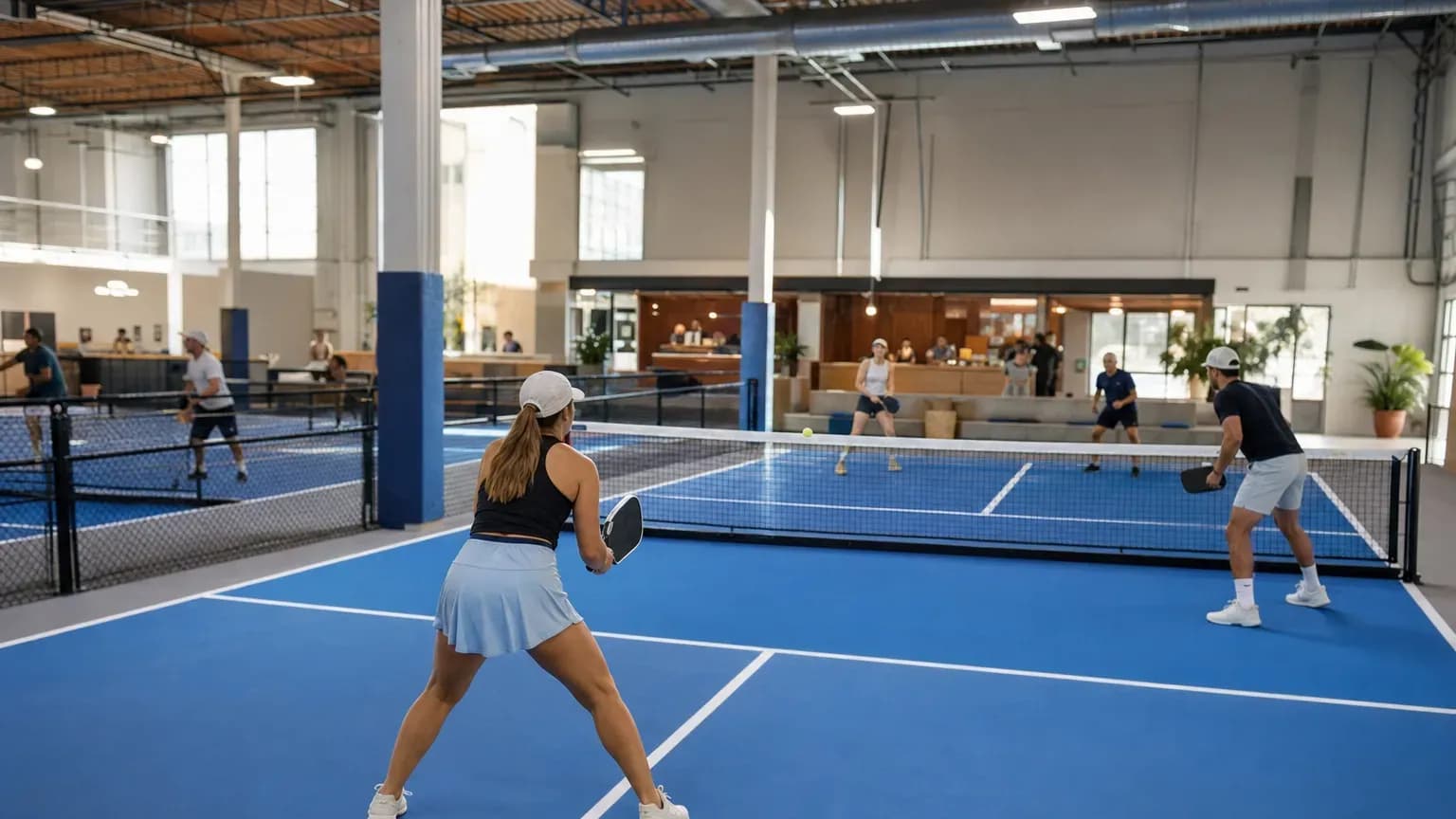
Starting a pickleball business comes down to five decisions: which format you'll run (programs on borrowed courts, an outdoor club or a dedicated indoor facility), where the demand is, how you'll pay for the build, how you'll price court time and how you'll fill the courts at off-peak times. A program-only business can start for a few thousand dollars. A leased indoor club with about eight courts typically needs $0.6M to $1.9M before it opens. This guide covers each step, a cost table, the revenue streams and a worked example of monthly court economics.
Step 1: Pick your business model
Pickleball businesses fall into three broad models. Your budget and how much risk you can carry decide which one fits.
Model | What it is | Typical capital | Main risk |
|---|---|---|---|
Programs only | Leagues, clinics and lessons on courts you rent from parks, schools or clubs | Low (equipment, insurance, marketing) | You don't control court access or prime-time hours |
Outdoor club | Owned or leased outdoor courts, often with lights | Medium | Weather and seasonality limit bookable hours |
Indoor facility | Leased or owned building with dedicated courts | High | Rent is fixed whether courts are booked or not |
Many operators start with programs to prove demand and build a player list, then use that list as evidence when they raise money for a building.
Step 2: Validate local demand
Before you look at buildings, collect evidence that people will pay.
- Count existing courts within a 15 to 20 minute drive and note which are public, private, indoor and lit.
- Visit public courts at peak times. Long waits for open play are a strong signal.
- Check what competitors charge for court rental, drop-in and memberships. Our guide to pickleball court rental pricing explains how operators set those rates.
- Run a pre-sale or waitlist. Ask for a small deposit on founding memberships or a first league season. A deposit tells you far more than an online survey does.
- Look at the climate. Indoor courts earn the most in places where outdoor play stops for winter or summer heat.
Step 3: Find a site and confirm the space works
Per the USA Pickleball rulebook, a pickleball court is 20 by 44 feet including lines. Playing areas need room around the court, and USA Pickleball's facility guidance suggests a total area of about 30 by 60 feet per court, with 34 by 64 feet preferred. Allow for walkways, a lobby, restrooms and storage on top of that. A rough planning figure for an eight-court indoor club is 20,000 to 28,000 square feet.
When you assess a building, check:
- Clear height. Low ceilings catch lobs. Ask an architect or court builder what clear height your planned play level needs.
- Column spacing. Columns inside run-off areas are a safety problem and may cost you a court.
- Floor. A flat, sound concrete slab is the usual base for an acrylic or cushioned court system.
- Zoning and occupancy. Confirm that recreation use is allowed and what code upgrades (sprinklers, exits, restrooms) the change of use triggers.
- HVAC and lighting. Warehouses rarely come with the cooling, heating or even lighting a court needs.
- Parking. Eight full doubles courts can put 32 players on site at once, plus the people waiting for the next slot.
Step 4: Build a startup budget
The table below is for a leased warehouse converted to eight indoor courts. It assumes a US metro area, a shell building that needs HVAC, lighting and restroom upgrades, and acrylic hard courts. The figures are typical quotes and planning ranges, not bids. Your local costs could fall outside them.
Category | Typical range | Assumptions |
|---|---|---|
Lease deposit and rent during build-out | $40,000–$120,000 | Security deposit plus a few months of rent before opening, unless you negotiate free rent |
Build-out (HVAC, lighting, restrooms, lobby, code work) | $300,000–$900,000 | Biggest variable; depends on the building's condition and local code |
Court surfaces and lines | $64,000–$200,000 | About $8,000–$25,000 per court; cushioned systems cost more than standard acrylic |
Nets, posts and divider netting | $12,000–$40,000 | Permanent posts and netting between courts |
Furniture, front desk and pro shop stock | $20,000–$60,000 | Seating, check-in desk, opening retail inventory |
Technology | $5,000–$20,000 | Booking software, Wi-Fi, cameras, door and front desk hardware |
Professional fees and permits | $25,000–$100,000 | Architect, engineer, attorney, accountant, permit fees |
Pre-opening marketing | $10,000–$40,000 | Founding member campaign, signage, launch events |
Working capital | $150,000–$400,000 | Three to six months of operating costs while you build demand |
Total | About $0.6M–$1.9M |
|
Outdoor courts on land you already control cost far less. Our pickleball court cost guide breaks down per-court construction.
Step 5: Plan your revenue streams
Court rental alone rarely carries an indoor club. Most facilities stack several income sources:
- Court rentals by the hour or 90 minutes, with peak and off-peak rates.
- Open play and drop-in sessions sorted by skill level, priced per player.
- Memberships that discount court time or include open play.
- Leagues sold per player or per team for a season.
- Lessons and clinics run by staff or contracted coaches, with the facility keeping a share.
- Tournaments and ladders with entry fees.
- Corporate and private events, such as team outings and birthday parties.
- Retail and equipment like paddles, balls, grips and demo paddle rental.
- Food and drink, from vending to a full bar if your license allows it.
- Sponsorships from local businesses for courts, leagues or events.
Step 6: Run the numbers on one month
Here is an illustrative monthly model for the eight-court club above. All numbers are assumptions chosen to show how the math works. They aren't benchmarks.
Assumptions:
- 8 courts open 15 hours a day, 30 days a month = 3,600 court-hours available
- 40% blended utilization (busy evenings and weekends, quiet weekday middays) = 1,440 booked court-hours
- $36 average yield per booked court-hour, blending rentals, open play and league time
- $18,000 a month from lessons, events, retail and drinks combined
- Costs exclude loan payments and the owner's salary
Line | Monthly amount |
|---|---|
Court revenue (1,440 × $36) | $51,840 |
Other revenue | $18,000 |
Total revenue | $69,840 |
Rent, including taxes and common charges | $30,000 |
Staff (front desk, manager, coaches' share) | $18,000 |
Utilities | $6,000 |
Payment processing and software | $3,000 |
Marketing | $3,000 |
Insurance | $2,000 |
Maintenance and supplies | $2,000 |
Total costs | $64,000 |
Operating profit before debt service | $5,840 |
Now look at what happens when only utilization changes:
Utilization | Court revenue | Total revenue | Operating result |
|---|---|---|---|
30% | $38,880 | $56,880 | −$7,120 |
40% | $51,840 | $69,840 | $5,840 |
50% | $64,800 | $82,800 | $18,800 |
60% | $77,760 | $95,760 | $31,760 |
Each 10 points of utilization moves the result by about $13,000 a month in this example. That's why your plan for off-peak hours (daytime leagues for retirees, school programs, corporate bookings) matters as much as your plan for prime time. Before you sign a lease, rebuild this table with your own rent, rates and hours.
Step 7: Set up the legal and financial basics
- Entity and accounts. Form an LLC or corporation, get an EIN (or a business number in Canada) and open a business bank account.
- Insurance. You'll need general liability that covers participants, property coverage for your build-out and equipment, and workers' compensation once you have staff. Liquor liability applies if you serve alcohol.
- Waivers. Collect a signed waiver from every player. Have a local attorney review it, because enforceability varies by state and province.
- Financing. Indoor clubs are often funded with a mix of owner equity, an SBA-backed loan in the US, equipment financing and founding-member pre-sales.
- Lease terms. Negotiate free rent during build-out, a tenant improvement allowance and an option to renew. A long build-out with no rent relief can use up your working capital before you open.
Step 8: Pre-sell and launch
Start selling before the courts are finished:
- Offer a limited number of founding memberships at a locked-in rate.
- Run pop-up clinics or leagues at nearby public courts and tell players about the new club.
- Partner with local ambassadors and coaches who already have followings.
- Pre-book leagues and corporate events for your first eight weeks.
- Plan an opening week with free demo sessions and skill-level open play so new players find partners.
Step 9: Operate for utilization
Once you're open, track a few numbers every week: utilization by hour block, revenue per available court-hour, new versus returning players, and cancellations. Move programs into empty time slots, adjust off-peak pricing and keep prime time for the bookings that pay the most. Set a clear cancellation policy from day one so a late cancellation doesn't leave a court empty and unpaid.
How to run bookings with booking software
The front desk can't run court rentals, open play and leagues from a spreadsheet for long. Sports Booking Management gives each court its own booking rules and operating hours. Players book from a public booking page without creating an account, and you can embed a booking button on your own website. Payments go through Stripe checkout, recurring bookings cover weekly leagues, and you can add paddle rental to a booking as an add-on. It's one plan at $79/month with unlimited courts and bookings; details are on our pricing page. For pickleball-specific setup, see our pickleball facility page.