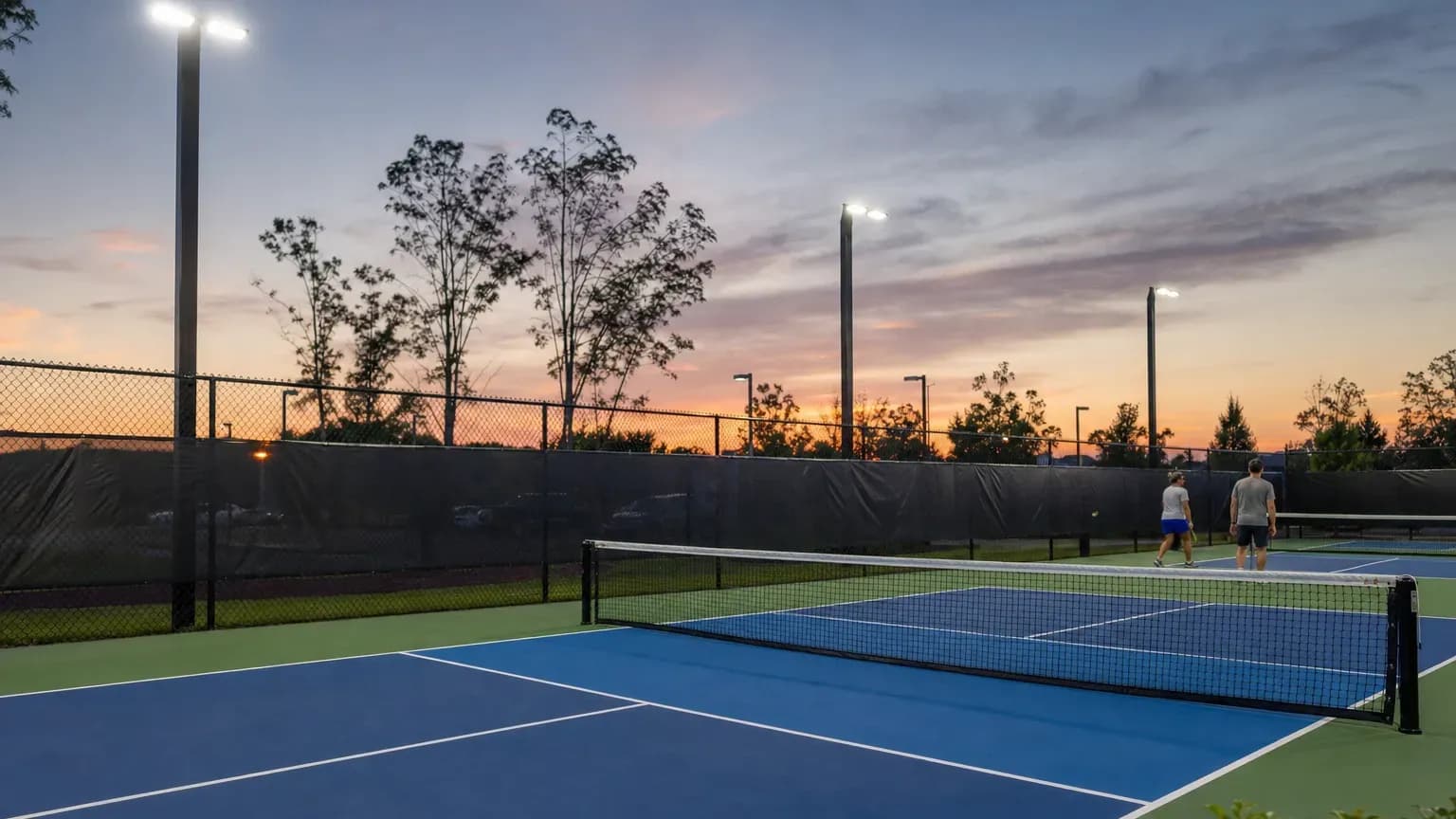
Building a new outdoor pickleball court in the US typically costs $25,000 to $55,000 per court in 2026 contractor quotes. A basic asphalt court with nets and lines sits near the low end. A post-tensioned concrete court with a cushioned surface, 10-foot fencing and LED lighting sits near the top. Converting an existing tennis court usually runs $5,000 to $20,000, and resurfacing an existing pickleball court is often $3,000 to $6,000. Indoor courts cost far more, because you're paying for a building: metal building shells alone are often quoted at $15 to $35 per square foot before surfacing, HVAC and lighting.
These ranges come from cross-checking several published 2026 cost guides from court builders and surface makers. They're typical quotes, not averages. Your number depends on site work, soil, local labor rates and how many courts you build at once.
What the cost assumes
The ranges in this guide assume:
- US pricing, 2026, from contractor-quote ranges published by court builders and surfacing suppliers
- One court on a 30 x 60 foot pad, which is the minimum total playing surface USA Pickleball recommends around the 20 x 44 foot lined court (34 x 64 feet is preferred for tournaments)
- A reasonably flat, buildable site with no rock removal, retaining walls or major drainage work
- New build unless stated, meaning base, surface, fencing, nets and lights from scratch
If you build several courts in one pad, the cost per court usually drops, because fencing, lighting and mobilization are shared. For court layout, see pickleball court dimensions.
Pickleball court cost by component (outdoor, new build)
Component | Typical range per court | What drives the price |
|---|---|---|
Site prep and grading | $2,000–$10,000 | Slope, soil, tree removal, drainage, access for equipment |
Base: asphalt | $5,000–$12,000 | Thickness, aggregate base, local asphalt prices |
Base: standard concrete | $9,000–$18,000 | Thickness, reinforcement, finish |
Base: post-tensioned concrete | $18,000–$25,000 | Cable system, engineering, specialist crew |
Acrylic color coat and lines | $2,000–$6,000 | Number of coats, color, line layout |
Cushioned acrylic upgrade | add $1,500–$3,000 | Number of cushion layers |
Fencing (about 10 ft chain-link) | $4,000–$10,000 | Height, gauge, coating, gates, shared fence lines |
Windscreens | $500–$2,000 | Coverage and material |
Net system | $500–$3,000 | Portable vs permanent posts in sleeves |
LED lighting | $4,000–$20,000 | Number of poles, fixture spec, electrical run to the court |
Permits and inspections | $200–$2,000 | Jurisdiction, stormwater or zoning review |
You only pay for one base type, so don't add all three rows. The widest swings are lighting and site work. A court close to an existing electrical panel on a flat lot can cost a fraction of one that needs a long trench and new service.
Worked example: three outdoor budgets
Here's how the components combine for one court at three spec levels. All figures fall inside the ranges above.
Line item | Basic | Mid-range | Premium |
|---|---|---|---|
Site prep and grading | $3,000 | $5,000 | $8,000 |
Base | Asphalt, $8,000 | Concrete, $13,000 | Post-tensioned, $22,000 |
Acrylic surface and lines | $3,000 | $4,000 | $5,000 |
Cushion upgrade | none | none | $2,500 |
Fencing and windscreens | $5,000 | $7,000 | $10,000 |
Nets | Portable, $600 | Permanent, $1,500 | Permanent, $2,500 |
Lighting | none | $8,000 | $14,000 |
Permits | $500 | $1,000 | $1,500 |
Total | $20,100 | $39,500 | $65,500 |
The basic build lands slightly under the usual range because it has no lights. The premium build lands above it, which is realistic for a single court built to a high spec. Spread across four courts on one pad, the premium build would come down per court, because fence runs and light poles are shared.
Indoor pickleball court costs
An indoor court costs mostly what the building costs. The main line items:
Item | Typical published range | Notes |
|---|---|---|
Floor area per court | about 2,100–2,500 sq ft | Court plus buffer space; more for walkways, seating and a front desk |
Pre-engineered metal building shell | $15–$35 per sq ft | Shell only; foundation, site work and finishes extra |
Court surface over concrete slab | $12,000–$25,000 per court | Acrylic or modular tile; cushioned systems cost more |
HVAC | about $4–$10 per sq ft | Climate, insulation, heating vs cooling load |
Lighting | $8,000–$20,000 | For a full indoor package, depending on court count |
Clear height | 18–20 ft minimum is the common builder guidance | Measure to the lowest truss, duct or fixture |
Many operators lease an existing warehouse instead of building. That swaps the shell cost for rent plus tenant improvements (lighting, HVAC upgrades, restrooms, a slab repair or overlay), and the price depends heavily on the building's condition. Get a contractor walk-through before signing any lease.
Converting a tennis court or resurfacing an existing court
You can fit up to four pickleball courts on a standard tennis court enclosure, which makes conversion the cheapest way to add courts. Published ranges:
Project | Typical range | What's included |
|---|---|---|
Add pickleball lines to a tennis court (blended lines) | toward the low end of $5,000–$20,000 | Layout, line paint, portable nets |
Full conversion to dedicated pickleball courts | toward the high end of $5,000–$20,000 | Resurfacing, new lines, permanent posts, interior divider fencing |
Acrylic resurfacing of an existing pickleball court | $3,000–$6,000 per court | Clean, minor crack repair, new color coat and lines |
Repair and overlay of a cracked base | $5,000–$15,000 per court | Crack repair systems or overlay, then resurfacing |
For layout and line-color questions, see can you play pickleball on a tennis court.
Running costs to budget after the build
The build is a one-time cost. These keep coming:
- Resurfacing every several years outdoors; set aside money monthly
- Annual upkeep, such as cleaning, crack sealing and net replacement; one published guide puts it at $500–$2,000 per court per year
- Electricity for lights (and HVAC indoors)
- Insurance, at least general liability
- Staff time for opening, closing and handling bookings
- Payment processing and software
Payback example: will the court pay for itself?
Payback depends on two numbers you control: your rental rate and your utilization (the share of available hours that get booked). Here's a simple model for one outdoor lit court.
Assumptions (illustrative):
- Build cost: $40,000 (close to the mid-range budget above)
- Bookable hours: 10 a day, 7 days a week = 70 hours a week
- Weeks per year: 52 (shorten this if winter closes the court)
- Operating costs for this court: $3,000 a year (upkeep, lighting, resurfacing reserve, processing)
- Ignores land, financing, taxes and staff you'd have anyway
Formula: annual revenue = rate x 70 hours x utilization x 52 weeks. Payback in years = $40,000 / (annual revenue − $3,000).
Hourly rate | 20% utilization | 35% utilization | 50% utilization |
|---|---|---|---|
$15 | $10,920 a year, payback 5.1 yrs | $19,110 a year, payback 2.5 yrs | $27,300 a year, payback 1.6 yrs |
$20 | $14,560 a year, payback 3.5 yrs | $25,480 a year, payback 1.8 yrs | $36,400 a year, payback 1.2 yrs |
$30 | $21,840 a year, payback 2.1 yrs | $38,220 a year, payback 1.1 yrs | $54,600 a year, payback 0.8 yrs |
Two things stand out. Utilization moves payback as much as price does, and a court that sits empty most of the day pays back slowly at any rate. Plug in your own rate (see pickleball court rental pricing for typical market rates), realistic hours for your climate, and your real operating costs.
For an indoor facility, run the same formula across all courts, then subtract rent or debt service, staff, utilities and insurance before dividing into your build or fit-out cost. Indoor courts can sell more hours a year, but those fixed costs are much higher.
Ways to lower the cost per court
A few decisions cut the budget without shortening the court's life:
- Build in a bank. Two or more courts on one pad share fence lines, light poles and mobilization. The fence between side-by-side courts can often be a low divider or a net rather than a full 10-foot fence.
- Phase the lighting. Run conduit to the court during the build, even if you add poles and fixtures later. Trenching through a finished site costs more than doing it once.
- Pick the base for your horizon. If you plan to hold the site for a long time, post-tensioned concrete can cost less over its life than asphalt that needs crack repair at every resurfacing. If you lease the land on a short term, the cheaper base may make more sense.
- Skip the cushion outdoors if budget is tight. A cushioned surface is a comfort upgrade, not a structural one, and it can be added at a later resurfacing.
- Reuse what you have. A sound tennis court or hard-surface area may only need resurfacing and lines.
Questions to ask contractors
Get at least three quotes, and ask each builder:
- What base thickness and type are you quoting, and what's the expected crack behavior?
- Is site prep included, and what happens if you hit rock or poor soil?
- How many acrylic coats, and is a cushion layer included?
- Is the lighting quote fixtures only, or poles, wiring and the electrical run too?
- Who pulls the permits?
- What's the warranty on the base and on the surface?
- When should I expect the first resurfacing?
Running the finished court
Once the court is built, payback depends on selling the hours. A booking system for pickleball facilities lets players see open times and pay when they book, which supports both the rate and the utilization in the payback table.
Sports Booking Management lets you set rates per court and by booking length, take payment online through Stripe checkout, and hold recurring slots for leagues and regular groups. Players book through a public page you can embed on your website. It's one plan at $79 a month with unlimited courts and bookings.