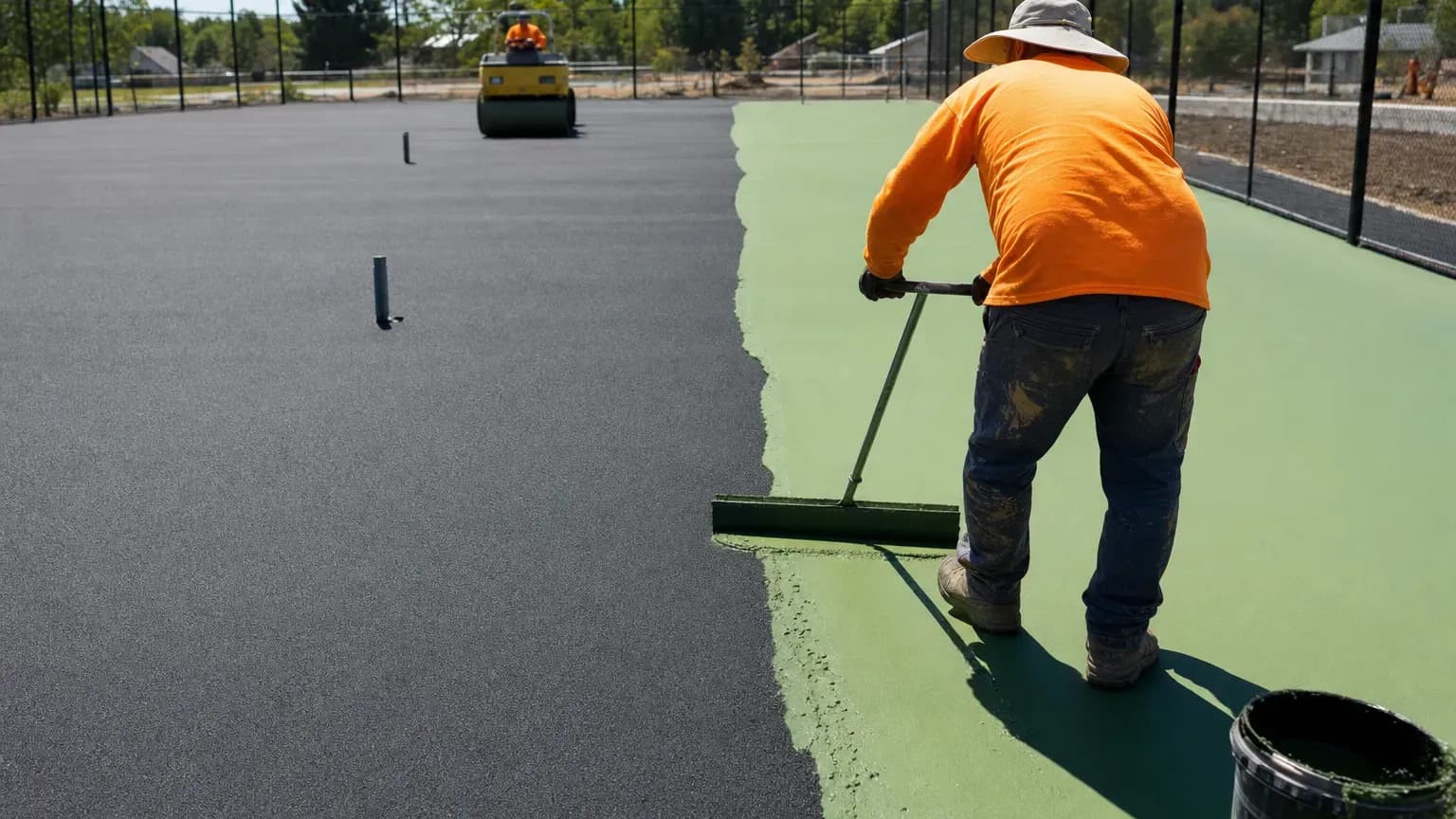
The cost to build a tennis court in the US typically runs $60,000 to $120,000 or more for one outdoor hard court in 2026 contractor quotes. An asphalt court with an acrylic surface and fencing but no lights sits toward the bottom. A post-tensioned concrete court with a cushioned surface and LED lighting can pass $150,000. The base is the biggest single cost, followed by lighting and fencing. Resurfacing an existing court costs far less, typically $5,000 to $12,000 for a recoat on a sound base, while a full teardown and rebuild can cost as much as a new court.
These are typical contractor-quote ranges, cross-checked across several published 2026 cost guides from court builders and surfacing suppliers. Your quote depends on your site, soil, region and spec.
Assumptions behind these numbers
- US pricing, 2026, outdoor court, new build unless stated
- One court on a 60 x 120 foot pad (7,200 sq ft), the single-court size recommended by the USTA and the American Sports Builders Association. See tennis court dimensions for the layout.
- Acrylic hard court surface, the most common choice for clubs and parks
- A buildable site without rock, major drainage problems or retaining walls
Tennis court cost by component
Component | Typical range per court | What drives the price |
|---|---|---|
Site prep, grading and drainage | $5,000–$15,000+ | Slope, soil, clearing, stormwater, equipment access |
Base: asphalt over aggregate | $25,000–$50,000 | Thickness, aggregate depth, local asphalt prices |
Base: post-tensioned concrete | $45,000–$80,000 | Cable system, engineering, specialist crew, slab thickness |
Acrylic color system and lines | $6,000–$12,000 | Number of coats, color, blended pickleball lines |
Cushioned surface upgrade | add $10,000–$25,000 | Number of cushion layers |
Fencing, about 10 ft chain-link, with gate | $10,000–$25,000 | Height, gauge, coating, windscreens, shared fence lines |
Net, posts and singles sticks | $500–$2,000 | Post type and footing |
LED lighting | $15,000–$50,000+ | Pole count, fixture spec, light level, electrical service |
Permits, survey and design | varies by jurisdiction | Zoning, stormwater review, engineering |
Use one base row, not both. Published guides disagree most on lighting: a basic residential setup costs far less than a club-grade system with full, even light across the court. Ask for a lighting layout with target light levels so you can compare quotes on the same basis.
Worked example: three tennis court budgets
These three budgets show how the line items combine for one court. Each line falls inside the ranges above, and the permit line is an allowance, not a quote.
Line item | Basic club court | Lit club court | Premium court |
|---|---|---|---|
Site prep and drainage | $8,000 | $10,000 | $12,000 |
Base | Asphalt, $30,000 | Asphalt, $35,000 | Post-tensioned, $60,000 |
Acrylic surface and lines | $8,000 | $9,000 | $10,000 |
Cushion upgrade | none | none | $15,000 |
Fencing and windscreens | $12,000 | $15,000 | $20,000 |
Net, posts, singles sticks | $1,000 | $1,500 | $2,000 |
LED lighting | none | $25,000 | $40,000 |
Permits and design allowance | $2,000 | $3,000 | $4,000 |
Total | $61,000 | $98,500 | $163,000 |
Build two courts together and the per-court number usually drops, because the shared fence between courts disappears and light poles can serve both sides.
Surface choices and what they mean for cost
Acrylic hard court. The standard for most US clubs and parks. Lower upkeep than clay or grass, but it needs periodic resurfacing. A cushion layer under the color coats softens the surface for players and adds cost.
Clay (including fast-dry). Popular with some clubs for player comfort and slower play. Build quotes vary widely by system, and clay needs daily or near-daily grooming plus seasonal top-dressing, so budget staff time and materials, not just the build. Get pricing from a specialist builder.
Natural grass. Rare outside dedicated clubs because of maintenance cost and weather limits.
Indoor courts. Indoors, the building is most of the cost. A 60 x 120 foot court needs 7,200 square feet of clear-span floor, and the ITF recommends 29.6 feet (9.0 m) of clear height at the net. That height and span push building costs up compared with lower, narrower sports like pickleball. As an illustration only: if a shell quote came in at $15 to $35 per square foot, the shell alone for one court's footprint would be $108,000 to $252,000, before the slab, surface, lighting, HVAC and finishes. Tennis-specific buildings and air structures need their own quotes.
Resurfacing and repair costs
If you already own a court, these are the projects you're more likely to price:
Project | Typical range | When you need it |
|---|---|---|
Acrylic recoat and new lines | $5,000–$12,000 | Faded color, worn lines, slick areas; base still sound |
Crack repair plus recoat | add to the recoat, depending on crack length and system | Cracks wider than a hairline, or cracks that keep returning |
Adding blended pickleball lines | usually done with a recoat | Adding a second sport to the court |
Full reconstruction | $75,000–$150,000+ | Failed base, heaving, drainage problems |
Lining a tennis court for pickleball as part of a recoat is one of the cheaper ways to add bookable hours. The trade-offs are covered in can you play pickleball on a tennis court, and the build cost of dedicated pickleball courts is in how much does a pickleball court cost.
Ongoing costs to plan for
- Resurfacing reserve: divide your expected recoat cost by the years between recoats and set that aside
- Annual upkeep: cleaning, crack sealing, net and windscreen replacement; one published guide puts general upkeep at $1,000 to $4,000 a year per court
- Electricity for lights
- Insurance, at least general liability
- Staff for opening, closing and handling bookings
Payback example for a club court
For an owner, the real question is whether court rental income pays back the build. A simple model uses two variables you control: the hourly rental rate and utilization, the share of open hours that are booked.
Assumptions (illustrative):
- Build cost: $90,000 (an outdoor lit asphalt court, near the middle budget above)
- Bookable hours: 12 a day, 7 days a week = 84 hours a week
- Season: 40 weeks a year outdoors (adjust for your climate)
- Operating costs for this court: $6,000 a year (upkeep, lighting, resurfacing reserve, processing)
- Ignores land, financing, taxes and memberships
Formula: annual rental revenue = rate x 84 hours x utilization x 40 weeks. Payback in years = $90,000 / (revenue − $6,000).
Hourly court rate | 20% utilization | 35% utilization | 50% utilization |
|---|---|---|---|
$25 | $16,800 a year, payback 8.3 yrs | $29,400 a year, payback 3.8 yrs | $42,000 a year, payback 2.5 yrs |
$35 | $23,520 a year, payback 5.1 yrs | $41,160 a year, payback 2.6 yrs | $58,800 a year, payback 1.7 yrs |
$50 | $33,600 a year, payback 3.3 yrs | $58,800 a year, payback 1.7 yrs | $84,000 a year, payback 1.2 yrs |
At low utilization the court takes years to pay back even at a high rate. The quickest way to improve the math is usually filling more hours (leagues, lessons, clinics and off-peak pricing) rather than raising the rate. Run the table again with your own local rates, season length and costs.
Ways to control the budget
Build two courts instead of one. If you have the land and the demand, a two-court bank usually costs less per court than two separate builds, because the fence between courts and the light poles are shared. ASBA guidelines call for at least 12 feet between sidelines of adjacent courts in a shared enclosure, so two courts fit in about 108 x 120 feet.
Run conduit now, add lights later. Lighting is one of the largest line items. If you can't afford it on day one, have the electrical conduit and pole footings planned and, where practical, installed during construction. Retrofitting through a finished court and fence costs more.
Match the base to how long you'll own it. A lower-cost asphalt base is reasonable for a shorter horizon. A longer horizon makes the higher cost of post-tensioned concrete easier to justify, since it's chosen to resist the cracking that drives repair costs.
Line for two sports at once. Adding blended pickleball lines while the surface crew is on site costs far less than a separate project later, and it gives you more ways to sell court time.
Get comparable quotes. Ask every bidder to price the same base, surface, fence height and lighting spec so you can compare like with like.
Questions to ask tennis court builders
- Are you an American Sports Builders Association member, and can I see courts you built five or more years ago?
- What base type and thickness are you quoting, and what crack behavior should I expect?
- What's included in site prep, and what triggers a change order?
- How many acrylic coats, and is cushion included?
- Is the lighting quote a full layout with target light levels, poles and electrical work?
- What are the warranties on the base, surface and lights?
- Who handles permits and stormwater approvals?
Keeping the court booked
A new court only pays back if the hours sell. A booking system for tennis facilities lets players see open times, book and pay without phoning the desk, which is how you move utilization in the payback table.
With Sports Booking Management, each court has its own hours and rates, including different rates by booking length. Players book on a public booking page you can embed on your website and pay through Stripe checkout. Recurring bookings hold weekly league nights and lesson blocks. It's $79 a month for unlimited courts and bookings.