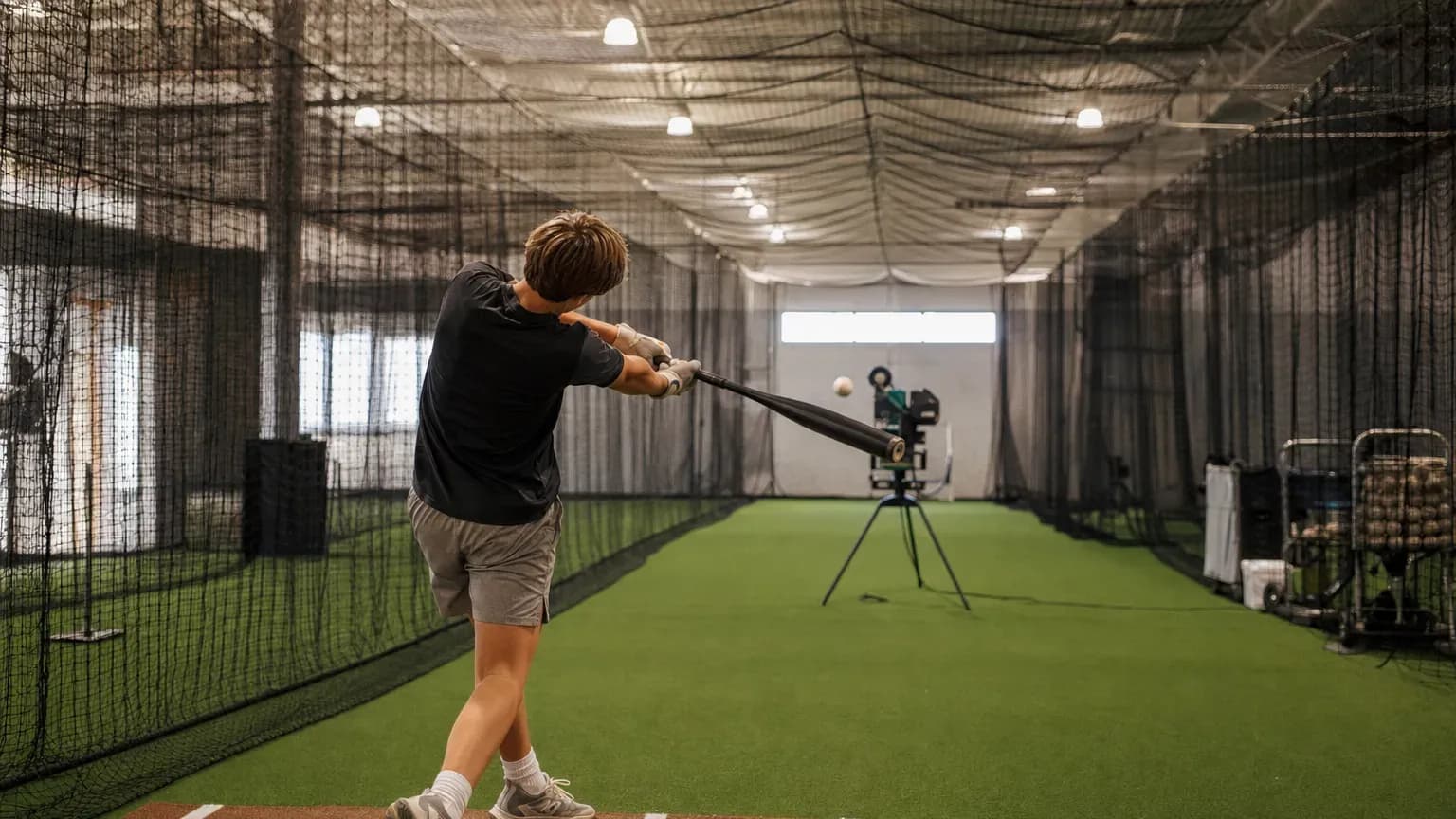
To start a batting cage business, you pick a format (indoor training center, outdoor cages or a mobile setup), confirm that local baseball and softball teams and families will book regular time, find a building with room for tunnels about 70 feet long, and fund equipment and build-out. A leased indoor facility with four to six tunnels commonly needs about $160,000 to $550,000 before opening. Most of the profit comes from lessons, team rentals and memberships stacked on top of hourly cage time. This guide walks through each step with a cost table, revenue streams and an illustrative month of numbers.
Step 1: Pick your format
Format | What it looks like | Capital | Main risk |
|---|---|---|---|
Indoor training center | Leased warehouse with tunnels, a turf training area and a lesson program | Medium to high | Fixed rent through slow months |
Outdoor cages | Tunnels on owned or leased land, often next to a family entertainment venue or ball fields | Low to medium | Weather, daylight and seasonality |
Add-on cages | Tunnels inside an existing gym, sports complex or school | Low | Shared space and limited hours |
Mobile cages | Portable tunnels and machines brought to events and teams | Low | Thin margins and travel time |
Indoor training centers are the most common standalone business because they sell to teams, private lesson clients and players training for tryouts all year.
Step 2: Validate local demand
Your best customers are recurring ones: travel teams, high school and college players, and families paying for weekly lessons. Before you look at buildings:
- List every Little League, travel ball, high school and college program within a 20 to 30 minute drive. Ask where they hit in the off-season and what they pay.
- Talk to private hitting coaches. Many coaches have clients but nowhere to teach. They can become tenants or partners and bring their customer base with them.
- Check existing cage facilities. Note their rates, hours, tunnel count and which hours they sell out.
- Ask teams for letters of intent for weekly winter cage time. A signed commitment is strong evidence for a lender or landlord.
- Consider your climate. Long winters or a rainy spring make indoor cages much more valuable.
Step 3: Size the building
A common tunnel size is 70 feet long, 14 feet wide and 12 feet high. That length leaves room for regulation pitching distance plus space behind the machine or L-screen. For reference, the pitching distance is 60 feet 6 inches under the Official Baseball Rules, 46 feet in Little League Baseball for most younger divisions, and 43 feet in NCAA fastpitch softball.
Facility plan | Approximate tunnel footprint | Typical total building |
|---|---|---|
4 tunnels | About 56 × 70 ft (≈3,900 sq ft) | 6,000–8,000 sq ft |
6 tunnels | About 84 × 70 ft (≈5,900 sq ft) | 8,000–12,000 sq ft |
8 tunnels plus training turf | About 112 × 70 ft (≈7,800 sq ft) plus turf | 12,000–18,000 sq ft |
The totals assume a lobby, restrooms, storage and an open turf area for fielding, throwing or strength work. Check ceiling height before you sign: you need clearance above the 12-foot net, plus room for lights and any retractable tunnel system. Confirm that the zoning allows recreation use and what code upgrades the change of use triggers.
Step 4: Build a startup budget
This table is for a leased indoor building of about 10,000 square feet with six tunnels and a small turf training area. It assumes a US metro area, a building that needs lighting, HVAC and restroom work, and new commercial equipment. These are typical quotes and planning ranges, not bids. For a closer look at the cages themselves, see our guide to how much a batting cage costs.
Category | Typical range | Assumptions |
|---|---|---|
Lease deposit and rent before opening | $15,000–$50,000 | Deposit plus a few months of rent during build-out |
Build-out (lighting, HVAC, restrooms, lobby, code work) | $50,000–$200,000 | Depends heavily on the building's condition |
Netting, frames and divider nets | $15,000–$45,000 | Six tunnels, commercial-grade netting, installation |
Pitching machines | $10,000–$35,000 | Retail listings for commercial arm and wheel machines run from about $1,700 to $5,700 each; add ball feeders and spares |
Turf and flooring | $15,000–$50,000 | Turf in tunnels and the training area |
L-screens, balls, bats, helmets and training gear | $5,000–$15,000 | Commercial-grade dimpled or leather balls wear quickly |
Furniture, front desk and retail | $5,000–$20,000 | Check-in desk, seating, opening retail stock |
Technology | $3,000–$10,000 | Booking software, Wi-Fi, cameras, optional ball-tracking units |
Professional fees and permits | $10,000–$40,000 | Attorney, accountant, permits, design |
Working capital | $30,000–$80,000 | Three to six months of operating costs |
Total | About $158,000–$545,000 |
|
The upper end assumes a heavier build-out and premium machines. Many owners cut the opening budget by starting with fewer machines, using some tunnels for coach-thrown lessons only, and adding equipment as demand grows.
Step 5: Plan your revenue streams
- Hourly and half-hour cage rentals for individuals and families.
- Team rentals sold as recurring weekly blocks through the off-season.
- Memberships with a set number of cage hours or unlimited off-peak use.
- Private and group lessons, run by staff or by independent coaches who pay you a rental fee or revenue share.
- Clinics and camps for hitting, pitching and catching, especially in school breaks.
- Leagues and contests, such as home run derby nights or velocity challenges.
- Birthday parties and team events.
- Retail, from batting gloves and balls to bat rentals.
- Sponsorship from local businesses on netting, walls and team programs.
Private lessons and team rentals are usually the backbone. Walk-in cage time is useful for filling gaps, but it tends to be busiest only on evenings and weekends.
Step 6: Run the numbers on one month
This is an illustrative model for the six-tunnel facility above. All figures are assumptions to show how the math works. They are not benchmarks.
Assumptions:
- 6 tunnels open 11 hours a day, 30 days a month = 1,980 tunnel-hours available
- 35% utilization = 693 booked tunnel-hours
- $45 average yield per booked tunnel-hour, blending walk-in, team and lesson tunnel use
- $9,000 a month from memberships, camps, parties and retail combined
- Lesson coach pay is covered inside staff costs; costs exclude loan payments and the owner's salary
Line | Monthly amount |
|---|---|
Tunnel revenue (693 × $45) | $31,185 |
Memberships, camps, parties and retail | $9,000 |
Total revenue | $40,185 |
Rent, including taxes and common charges | $12,500 |
Staff and coaches | $14,000 |
Utilities | $2,500 |
Insurance | $1,200 |
Equipment repair, balls and supplies | $1,500 |
Marketing | $1,500 |
Payment processing and software | $1,300 |
Total costs | $34,500 |
Operating profit before debt service | $5,685 |
Here is the same model at different utilization levels:
Utilization | Tunnel revenue | Total revenue | Operating result |
|---|---|---|---|
25% | $22,275 | $31,275 | −$3,225 |
35% | $31,185 | $40,185 | $5,685 |
45% | $40,095 | $49,095 | $14,595 |
55% | $49,005 | $58,005 | $23,505 |
Seasonality matters more for cages than for most sports. Winter and early spring may run well above your average, while summer can drop once outdoor fields open. Build a 12-month version of this table with monthly utilization, not a single average. Our sports facility business plan guide explains how to lay out that projection.
Step 7: Handle legal, safety and insurance
- Entity and accounts. Form an LLC or corporation, get an EIN or Canadian business number and open a business bank account.
- Waivers. Every hitter, or a parent for minors, should sign a waiver before entering a tunnel. Have a local attorney review it.
- Insurance. You'll need general liability that covers participants, property coverage for machines and netting, and workers' compensation once you hire. Youth programs often need abuse and molestation coverage. Our sports facility insurance guide covers each type.
- Safety rules. Require helmets, post machine rules, keep L-screens in good repair, inspect netting for holes and wear, and train staff to set machine speed by age.
- Coach agreements. If independent coaches teach in your tunnels, put rental terms, insurance requirements and background check rules in writing.
Step 8: Launch and fill the off-peak hours
Sign team contracts for your first winter before you open, and recruit two or three hitting coaches who already have clients. After launch, fill school-day hours with homeschool groups, adult softball players, college players on breaks and early-morning sessions for serious hitters. Keep prime evenings for team blocks and lessons, and set a clear cancellation policy so no-shows don't cost you a tunnel.
How to run cage bookings with booking software
Cage facilities juggle walk-ins, weekly team blocks and coaches booking tunnels for lessons. Sports Booking Management sets each tunnel up as its own space with its own hours and rates, so you can price by the half-hour, hour or a flat fee. Recurring bookings cover team blocks for a whole season, and bat or helmet rental can be added to a booking as an add-on. Customers book and pay through Stripe checkout from a public booking page, without an account, and you can give coaches staff access with a booking role. It's one plan at $79/month with unlimited spaces and bookings. See how it works for batting cage facilities.